

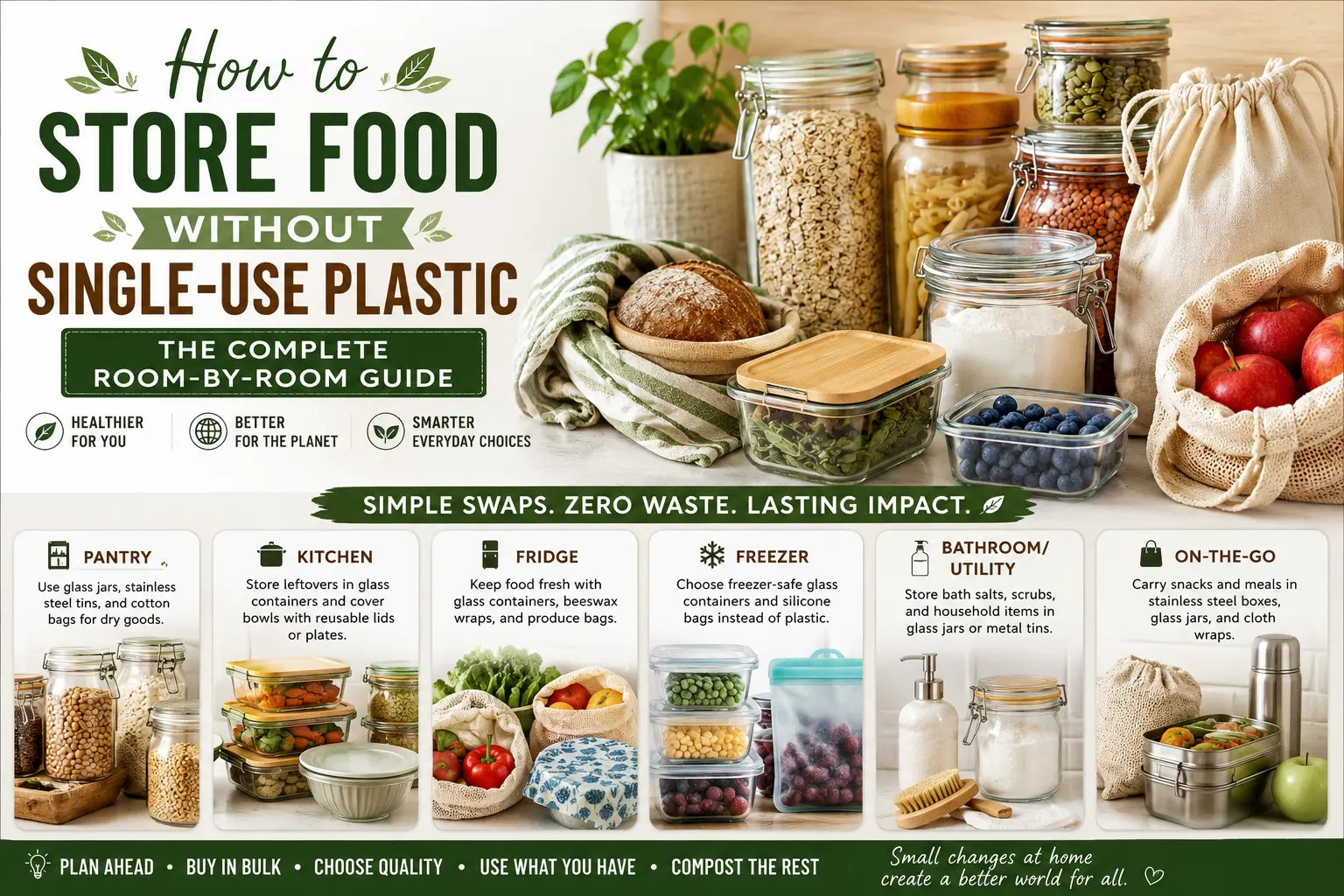
Open almost any refrigerator or pantry and you’ll find the same story repeating itself: cling film stretched over a bowl, a crumpled sandwich bag, a yogurt tub repurposed one too many times, a produce bag balled up in a drawer. Single-use plastic has quietly become the default answer to a very old question — how do we keep food fresh? — and most of us never really chose it. It just showed up, cheap and convenient, and stayed.
But learning how to store food without single-use plastic isn’t about performing some elaborate, expensive lifestyle overhaul. It’s a series of small, durable swaps that, once made, you barely think about again. This guide walks through exactly why plastic-free food storage matters, which materials actually work, and how to rebuild your kitchen — fridge, freezer, pantry, and lunchbox — around reusable systems that last for years instead of minutes.
By the end, you’ll have a practical, room-by-room plan for plastic-free food storage that saves you money, reduces waste, and — as a growing body of research suggests — may reduce your exposure to microplastics and chemical leaching as well.
Table of Contents
- Why Ditch Single-Use Plastic for Food Storage?
- The Hidden Health Case: Microplastics and Chemical Leaching
- The Best Plastic-Free Food Storage Materials
- Setting Up a Plastic-Free Pantry
- Plastic-Free Refrigerator Storage
- Freezing Food Without Plastic
- Plastic-Free Lunches and On-the-Go Meals
- Shopping Habits That Reduce Plastic Before It Enters Your Home
- Budget-Friendly Ways to Start (Without Buying Everything at Once)
- Common Mistakes to Avoid
- A 30-Day Plastic-Free Kitchen Challenge
- Frequently Asked Questions
1. Why Ditch Single-Use Plastic for Food Storage?
Single-use plastic — cling wrap, sandwich bags, disposable containers, plastic wrap on produce — is designed to be used once and thrown away. That “convenience” carries a real cost.
- The waste problem is enormous and personal: The average household generates a surprising volume of kitchen plastic waste every single week, most of it destined for landfill or incineration rather than recycling, since flexible films like cling wrap and bags are notoriously difficult for municipal recycling systems to process. Even plastics stamped with a recycling symbol frequently end up rejected at the sorting facility because they’re contaminated with food residue or made of mixed materials that can’t be separated.
- It’s also expensive over time: A roll of cling film or a box of sandwich bags feels cheap at the checkout, but multiplied across a year — or a decade — of grocery shopping, the cost of continuously repurchasing disposable storage adds up to far more than a one-time investment in glass jars, steel tins, or silicone bags that are reused thousands of times.
- And it’s a values mismatch for a lot of people: Many of us care about reducing our environmental footprint but feel like the “big” solutions (buying an electric car, installing solar panels) are out of reach. Food storage is one of the rare areas where the fix is immediate, visible, and entirely within your control. You can change how you store food today, and the plastic waste stops today too.
Switching to sustainable food storage isn’t about being perfect. It’s about swapping the highest-impact, easiest-to-replace items first, then building outward from there.
2. The Hidden Health Case: Microplastics and Chemical Leaching
Beyond the environmental argument, there’s a health-driven reason more people are searching for eco-friendly food storage options: what plastic does when it meets heat, cold, and time.
Plastic isn’t as stable as it looks. Freezer-safe glass and steel containers offer a more durable alternative to plastic for freezing leftovers, because plastic can become brittle when frozen, which can cause tiny fragments to break off and release as microplastics. The same instability shows up at the other end of the temperature scale — heating food in plastic containers increases the release of microplastics, which can leach directly into the food itself.
That doesn’t mean every plastic container in your kitchen is dangerous. Everyday plastic tupperware is generally considered fine for short-term, room-temperature or fridge storage. The concern intensifies specifically around freezing and reheating, the two situations where plastic is put under the most physical and chemical stress. So while plastic containers work for everyday storage and chilling, it’s worth having non-plastic alternatives on hand specifically for freezer prep and microwave reheating.
The practical takeaway: glass, stainless steel, and ceramic don’t have this problem. They don’t degrade under heat, they don’t leach chemicals, and they don’t shed microplastic fragments when frozen. That’s why they form the backbone of most plastic-free food storage systems.
3. The Best Plastic-Free Food Storage Materials
Before rebuilding your kitchen, it helps to understand the materials you’ll actually be relying on. Each has strengths, weaknesses, and a “best use case.”
Glass
Glass is the workhorse of plastic-free storage. It’s non-porous, doesn’t absorb odors or stains (no more permanently tomato-sauce-tinted containers), goes straight from freezer to oven to microwave in most cases, and lasts essentially forever if you don’t drop it. Glass is safe and non-toxic, won’t leach chemicals into food, and is easy to clean and reuse over and over again.
Best for: pantry staples, leftovers, meal prep, freezing soups and sauces (leave headspace for expansion), reheating.
Stainless Steel
Steel containers are lightweight, shatterproof, and don’t retain smells the way plastic can. They’re ideal for anything that travels — lunchboxes, camping trips, hiking snacks — because they can survive a drop that would shatter glass.
Best for: lunchboxes, dry snacks, travel, freezer storage of solid foods.
Beeswax Wraps
A reusable alternative to cling film, beeswax wraps are cotton cloth infused with beeswax, tree resin, and jojoba oil. The warmth of your hands softens the wax enough to mold the wrap around a bowl, a cut avocado, or a half a lemon, and it holds its shape as it cools. You can buy beeswax wraps as a completely plastic-free option, or make your own by dipping pieces of cotton into melted beeswax.
Best for: covering bowls, wrapping cheese, cut fruit and vegetables, sandwiches. Not suitable for raw meat or the freezer.
Silicone
Reusable silicone bags and stretchy silicone lids are a middle-ground option: not plastic-free in the strictest chemical sense, but plastic-waste-free, since a single food-grade silicone bag replaces hundreds of disposable plastic ones. Good silicone is inert, dishwasher-safe, freezer-safe, and often microwave-safe.
Best for: freezer storage of liquids and portioned foods, marinating, snacks on the go.
Ceramic
Ceramic dishes and crocks with lids are a beautiful, durable option for pantry and fridge storage, particularly for items you want on display — flour, sugar, coffee. They’re heavier and more breakable than steel, but oven-safe and completely non-reactive.
Best for: pantry canisters, baked goods, fridge storage of dips and spreads.
Paper, Wax Paper, and Cloth
Not every solution needs to be a rigid container. Butcher paper used to be the standard for freezer storage — meat wrapped in sturdy paper and placed straight into the freezer, no plastic required. Beeswax-free cotton produce bags, linen bread bags, and unbleached parchment all have a place in a low-plastic kitchen, particularly for bread, root vegetables, and bulk dry goods that need to breathe.
4. Setting Up a Plastic-Free Pantry
The pantry is often the easiest place to start, because most of what lives there is dry and shelf-stable, which means the storage material doesn’t need to be freezer-rated or microwave-safe — it just needs to keep air, moisture, and pests out.
- Start with a glass jar system: Standardized glass jars (mason jars, Weck jars, or a matching canister set) let you decant rice, pasta, oats, flour, sugar, nuts, and dried fruit out of their original plastic bags the moment you get home. Buying staples like rice, pasta, and nuts in bulk and using glass jars to keep what you need on hand is one of the most effective ways to cut plastic waste in the kitchen.
- Be selective about paper: It’s tempting to think any non-plastic packaging is automatically better, but paper isn’t right for everything. Paper bags aren’t a great option for storing dry goods like pasta or cereal long-term, even though they look attractive on a shelf — glass or steel holds up better. Save paper and cloth bags for shorter-term storage or for produce that needs airflow, like potatoes and onions.
- Use bulk bins whenever they’re available: Buying grains, spices, and pulses from bulk bins or a local refill store lets you skip packaging entirely. Bring your own glass jars or cloth bags, have them weighed empty at the register (most bulk stores are set up for this), and fill directly.
- Label everything: Once your pantry staples are all sitting in identical glass jars, they start to look alike fast. A simple chalk marker or a set of reusable labels saves you from mystery-flour incidents.
- Rotate stock front-to-back: Plastic-free storage doesn’t automatically prevent spoilage — good habits still matter. When you refill a jar, put the older stock at the front so it gets used first.
5. Plastic-Free Refrigerator Storage
The fridge is where most single-use plastic still sneaks in: cling film over bowls, produce bags around lettuce, deli-counter plastic wrap around cheese. Here’s how to phase it out.
- Replace cling film with a lid, a wrap, or a plate: You genuinely don’t need cling film for most fridge tasks. There are plenty of alternatives — you can store food in airtight containers, pop a plate over a bowl as a makeshift lid, or use reusable bowl covers or beeswax wraps instead of clinging to disposable wrap.
- Store leftovers in glass with tight-fitting lids: This is the single highest-impact swap most people make. Most cooked leftovers can safely be kept in the refrigerator for three to four days when stored at or below 40°F in airtight containers, and proper sealing and labeling helps prevent spoilage.
- Wrap cheese and produce in beeswax wraps or cloth: Hard cheese in particular does well wrapped loosely in beeswax paper or cloth rather than sealed in plastic, which can trap moisture and encourage mold.
- Ditch produce bags at the store: Choosing to refuse single-use plastic bags for fruit and vegetables — either keeping produce loose or using a reusable mesh bag — is one of the simplest swaps, and a durable mesh bag can last for years, replacing hundreds of disposable ones.
- Use a butter dish and an egg tray: Small, dedicated containers for individual items (a ceramic butter dish, a metal egg holder) remove the need for the plastic tubs those items often come packaged in.
6. Freezing Food Without Plastic
The freezer is the one area where plastic causes the most concern, both structurally (plastic gets brittle in the cold) and chemically (repeated freeze-thaw cycles stress the material). Fortunately, it’s also one of the easiest areas to fix.
- Glass and steel are your best friends here — with one rule: leave headspace: Liquids expand as they freeze, so fill glass containers no more than three-quarters full to avoid cracking.
- Use wide-mouth jars for soups, stocks, and sauces: Straight-sided glass jars (not the ones that curve inward near the top) release their frozen contents more easily and are less prone to cracking.
- Try the “freeze then bag” method for portions: Freeze individual portions of soup, sauce, or stew in a lidded container or on a tray first, then pop the solid block out and store it in a reusable silicone bag. This gets you the space-saving flatness of a bag without needing the food to touch plastic while it’s freezing.
- Butcher paper still works: For meat specifically, wrapping it tightly in sturdy butcher or freezer paper before it goes into the freezer is a tried-and-tested, plastic-free method that predates the plastic-wrap era entirely. Double-wrap for anything staying frozen longer than a month to guard against freezer burn.
- Foil is a reasonable backup, not a first choice: If you genuinely need a single-use wrap for something, aluminium foil is a better option than plastic wrap, since it’s widely accepted in kerbside recycling — just scrunch it into a ball at least the size of a golf ball before it goes in the bin.
7. Plastic-Free Lunches and On-the-Go Meals
Packed lunches and snacks-on-the-go are where disposable plastic multiplies fastest — a sandwich bag here, a snack-size bag there, a disposable cutlery set from the drawer. A few swaps eliminate almost all of it.
- A stainless steel or glass bento box with built-in compartments replaces the need for individual bags inside a lunchbox.
- A beeswax or cloth sandwich wrap does the job of a plastic bag and folds flat for the next day.
- A small steel or glass jar is perfect for dressings, dips, yogurt, or overnight oats — and doubles as your container at home.
- A reusable water bottle and a set of travel cutlery (bamboo or steel) round out a genuinely plastic-free kit that fits in most bags.
- Cloth napkins instead of paper towels for wiping hands cut down on another disposable habit that often ships wrapped in plastic itself.
None of this needs to be purchased all at once, and none of it needs to be fancy — a jam jar washed out and reused works exactly as well as a purpose-bought container.
8. Shopping Habits That Reduce Plastic Before It Enters Your Home
Storage habits matter, but the most effective move is reducing how much plastic comes home with you in the first place.
- Bring your own bags — for everything, not just groceries: Keeping reusable bags by the front door means you’re never caught having to fall back on a single-use plastic bag at the store.
- Choose loose produce over pre-packaged: Avoiding pre-cut fruit, small snacks, or anything single-serve is worth it, since these items almost always come in excessive packaging. A whole cantaloupe generates zero plastic; the same fruit pre-cut into a plastic clamshell generates a container that will likely never be recycled.
- Bring your own containers to delis and bulk counters: Bringing your own clean containers when buying prepared meals, snacks, or ingredients is an effective way to avoid packaging that’s often used for only a few minutes — many stores are happy to fill a container you bring, so it’s worth asking staff directly.
- Look for paper or glass packaging as a default swap: Many spreads, preserves, sauces, and drinks are available packaged in glass rather than plastic, and it’s worth scanning your regular grocery list for items where a glass or cardboard version already exists on the shelf.
- Shop bulk bins for pantry staples: As mentioned above, refill stores and bulk bins let you buy exactly the quantity you need with zero new packaging, using jars or bags you already own.
9. Budget-Friendly Ways to Start (Without Buying Everything at Once)
You don’t need a fully outfitted plastic-free kitchen on day one. In fact, trying to buy everything at once is one of the fastest ways to abandon the habit — it feels expensive and overwhelming. Instead:
- Use what you already own first: Empty jam jars, pickle jars, and pasta sauce jars are free glass containers. Wash off the label and they’re indistinguishable from a purpose-bought mason jar.
- Replace one category at a time: Start with whatever you throw away most — cling film is usually the biggest single offender — and replace only that before moving to the next category.
- Buy secondhand: Glass storage jars, ceramic canisters, and steel tins show up constantly at thrift stores and yard sales for a fraction of retail price.
- Prioritize the freezer and microwave swaps first, since those are the situations where plastic degradation and microplastic release are most pronounced.
- Make your own beeswax wraps: A yard of cotton fabric, a block of beeswax, and an iron are all you need — tutorials are widely available online, and a homemade set costs a fraction of a store-bought one.
10. Common Mistakes to Avoid
- Buying too much, too fast: A kitchen full of unopened glass jars and beeswax wraps you haven’t started using yet isn’t progress — it’s clutter with good intentions. Introduce new systems gradually so they actually get used.
- Forgetting that not all plastic needs to go immediately: Perfectly functional plastic containers you already own don’t need to be thrown in the bin just because they’re plastic — that creates waste of its own. Use them out their useful life for non-freezer, non-microwave tasks, and replace them with non-plastic options only as they wear out.
- Using beeswax wraps for raw meat or in the freezer: Beeswax wraps aren’t designed for either — the wax coating isn’t rated for raw meat contact or sub-freezing temperatures. Stick to glass, steel, or freezer paper for those tasks.
- Overfilling glass containers before freezing: Skipping the headspace rule is the most common reason people say “glass shattered in my freezer” and go back to plastic. Leave room for expansion and this simply won’t happen.
- Assuming all plastic packaging is recyclable: Flexible films and mixed-material packaging frequently aren’t accepted by curbside recycling even when they carry a recycling symbol — checking your specific municipality’s rules (or simply avoiding the packaging in the first place) avoids false confidence.
11. A 30-Day Plastic-Free Kitchen Challenge
If you’d like a structured way to work through this guide, try spacing the swaps out over a month rather than doing everything in one weekend:
- Week 1 — Pantry: Decant three dry goods into glass jars you already own. Start using reusable produce bags on your next grocery trip.
- Week 2 — Fridge: Replace cling film with a plate, a bowl cover, or a beeswax wrap for one week straight. Notice how rarely you actually miss it.
- Week 3 — Freezer: Freeze your next batch of soup, sauce, or portioned meat in glass or freezer paper instead of plastic bags.
- Week 4 — On-the-go: Pack lunch in a steel or glass container for five days running, and swap one disposable habit (napkins, cutlery, or water bottles) for a reusable version.
By day 30, most of the highest-plastic areas of a typical kitchen are already covered — and the swaps that remain (say, condiment bottles that only come in plastic) are usually genuinely hard to avoid rather than a matter of habit.
12. Frequently Asked Questions
Is it actually safer to store food in glass instead of plastic?
For freezing and reheating specifically, yes — glass and steel don’t degrade under temperature stress the way plastic can, and they don’t leach chemicals or shed microplastic fragments into food. For short-term, room-temperature, or fridge storage, food-grade plastic containers are generally considered fine.
What’s the best plastic-free alternative to cling film?
Beeswax wraps are the most popular reusable option for covering bowls and wrapping cut produce or cheese. For everyday tasks, a plate over a bowl or a stretchy silicone lid works just as well and costs nothing extra.
Can I put beeswax wraps in the freezer or wash them in hot water?
No — beeswax wraps aren’t freezer-safe, and hot water will melt the wax coating. Wash them in cool or lukewarm water with a mild soap and let them air dry.
Is silicone actually “plastic-free”?
Not in the strictest chemical sense — silicone is a synthetic polymer. But food-grade silicone is inert, doesn’t leach chemicals, and a single reusable silicone bag replaces hundreds of single-use plastic ones, which is why it’s widely included in plastic-waste-free kitchen systems even if it isn’t technically plastic-free.
How do I store bread without a plastic bag?
A linen or cotton bread bag keeps a loaf’s crust from going soft while still letting it breathe, which actually extends freshness compared to a sealed plastic bag. A bread box works well too.
Final Thoughts
Learning how to store food without single-use plastic isn’t about achieving some perfect, plastic-free ideal overnight. It’s about noticing where disposable plastic has quietly become the default in your kitchen — the cling film drawer, the produce bag roll, the stack of takeout containers repurposed as leftovers boxes — and replacing those defaults, one at a time, with materials that are built to be used again and again.
Start with whatever you already own. Add a few glass jars, a beeswax wrap, or a steel lunchbox as they make sense for your routine. Within a few months, most kitchens following this approach find that single-use plastic has gone from the default option to the rare exception — which is exactly the point.
