

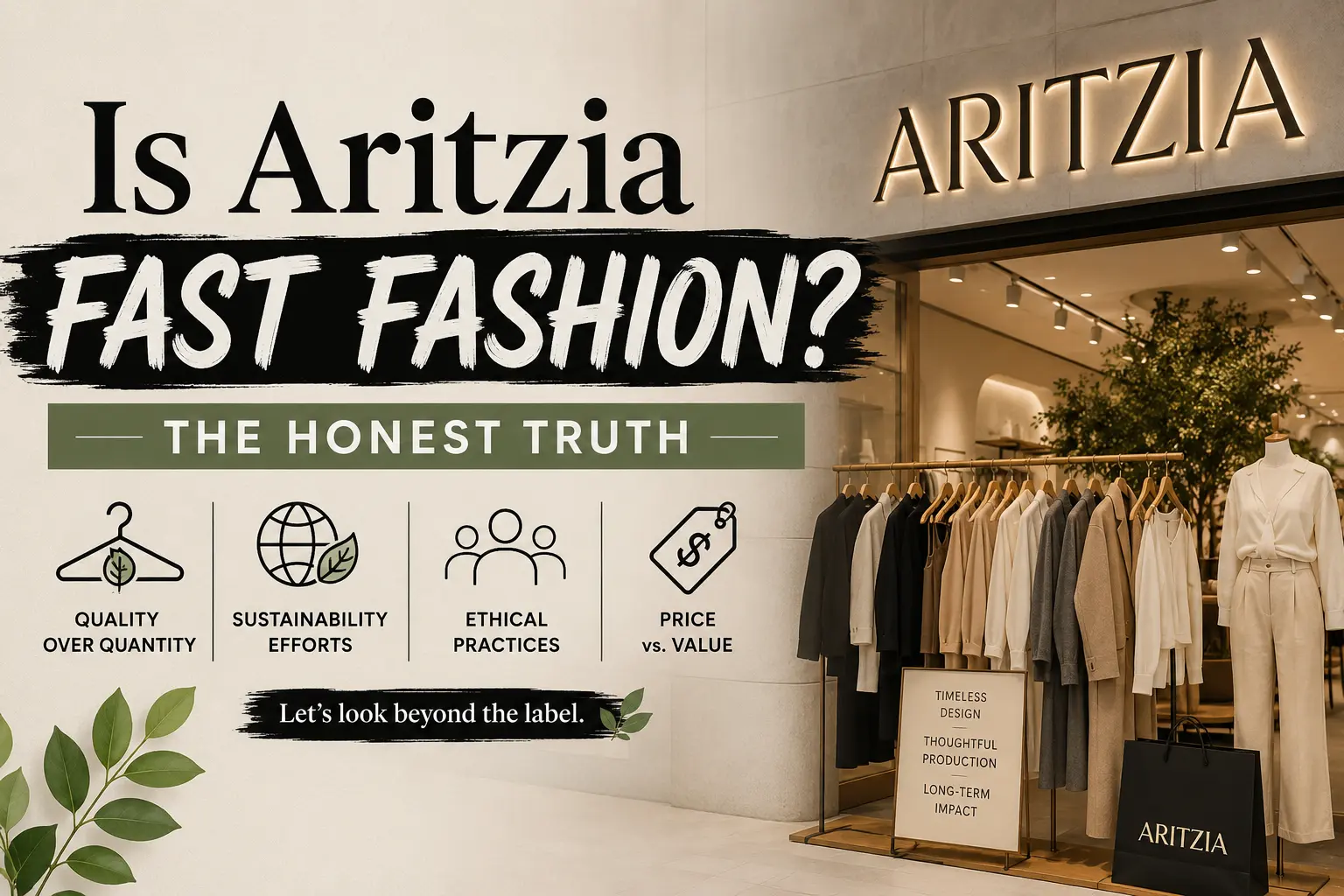
Walk into an Aritzia boutique and the first thing you notice isn’t a price tag — it’s the atmosphere. Soft lighting, minimalist mannequins, folded cashmere, and a hush that feels closer to a design showroom than a mall retailer. It’s a world away from the fluorescent-lit, overstuffed racks most people associate with fast fashion. So when shoppers ask, “is Aritzia fast fashion?” — the instinctive answer is usually no.
But the fashion industry rarely offers such a tidy answer. Aritzia has built a multi-billion-dollar business on the idea of “Everyday Luxury,” yet its supply chain, release cadence, and material choices tell a more complicated story than its polished branding suggests. This guide takes a deep, evidence-based look at Aritzia’s business model, manufacturing footprint, materials, pricing, and sustainability record to finally settle the debate — is Aritzia fast fashion, slow fashion, or something in between?
What Does “Fast Fashion” Actually Mean?
Before judging Aritzia, it helps to define the term properly, because most people use “fast fashion” as shorthand for “cheap clothing” — and that’s not quite right.
Fast fashion is a business model, not a price point. It’s defined by a handful of core characteristics:
- Speed: Trends move from runway or social media to store shelves within weeks, not months.
- Volume: Brands release enormous numbers of new styles constantly, rather than a handful of seasonal collections.
- Trend-chasing: Designs mimic current cultural moments rather than timeless silhouettes.
- Low production cost: Garments are made as cheaply as possible, often using synthetic fabrics and factories with minimal oversight.
- Encouraged disposability: The business depends on customers buying again and again, treating clothing as short-lived rather than an investment.
Brands like Shein, Zara, Fashion Nova, and H&M are the textbook examples. They release hundreds — sometimes thousands — of new products weekly, price items low enough to encourage impulse buys, and rarely publish detailed information about where or how their garments are made.
A brand doesn’t need to charge $10 for a t-shirt to qualify as fast fashion. It just needs to follow the same underlying playbook: constant novelty, high volume, and limited transparency, regardless of what the price tag says.
Aritzia: A Quick Brand Overview
Aritzia was founded in Vancouver, Canada, in 1984 by Brian Hill. Over four decades, it has grown from a single boutique into a publicly traded, multi-billion-dollar apparel company with hundreds of stores across Canada and the United States. The company markets itself under the “Everyday Luxury” positioning — clothing designed to sit between mass-market fast fashion and true luxury design houses.
Aritzia doesn’t rely on a single label. Instead, it operates a portfolio of in-house brands, including:
- Wilfred — feminine, tailored pieces
- Babaton — sleek, minimalist workwear and eveningwear
- TNA — casual, lounge-inspired basics
- Sunday Best and other rotating in-house lines
This multi-brand structure lets Aritzia constantly introduce “new” product without technically launching a new company or label — a strategy that keeps its assortment feeling fresh while reinforcing brand loyalty across different customer needs.
Financially, the company has continued to grow aggressively. In its most recent fiscal year, Aritzia reported strong double-digit revenue growth, driven heavily by expansion into the United States, new flagship boutiques, and rising e-commerce traffic. In its fourth quarter, net revenue increased 31.3% to $895.1 million, with U.S. net revenue climbing 48.5% and now accounting for more than 61% of total sales. That kind of scale and expansion pace is itself worth noting — genuinely slow, small-batch fashion brands rarely post growth numbers like these.
Where Are Aritzia Clothes Actually Made?
This is one of the most important — and most overlooked — questions in the fast fashion debate. Design headquarters and manufacturing location are two entirely different things.
Aritzia is headquartered, designed, and merchandised out of Vancouver, but virtually none of its clothing is manufactured in Canada. Instead, production happens through third-party supplier factories spread across several countries, most commonly cited as China, Vietnam, Cambodia, Turkey, Romania, and Peru.
This overseas manufacturing model isn’t unusual — it’s standard practice across nearly the entire apparel industry, including many brands that market themselves as ethical or sustainable. What actually separates a responsible brand from an exploitative one isn’t where the factories are, but how transparent the company is about conditions inside them: wages, hours, safety audits, and independent verification.
Still, independent monitoring groups continue to flag Aritzia’s disclosure as incomplete. Its score on the Fashion Transparency Index — an independent benchmark that rates major apparel brands on how much they publicly disclose about their supply chains — has reportedly remained in the 21–30% range, and ethical-shopping directory Good On You has rated the brand “Not Good Enough” on supply chain transparency.
Aritzia’s Pricing: Premium, But Not Luxury
Pricing is often the first thing people point to when arguing Aritzia isn’t fast fashion — and it’s a fair point, up to a level. Aritzia sits firmly in the “accessible luxury” or “premium contemporary” tier:
- Basic tees and tanks: roughly $35–$60
- Sweaters and knitwear: roughly $80–$180
- Tailored blazers and dresses: roughly $150–$350
- Outerwear, including the brand’s famous Super Puff jacket: roughly $300–$500+
That’s three to five times higher than what you’d typically pay at a true fast fashion retailer for a comparable item. This pricing does create some natural friction against pure fast fashion behavior — customers are less likely to buy on impulse and discard a $300 coat the way they might a $15 top from an ultra-fast retailer.
But price alone doesn’t disqualify a brand from fast fashion status. Higher prices simply mean the cost of chasing trends and buying frequently is higher for the consumer — it doesn’t change the underlying business mechanics driving the purchases in the first place.
How Fast Does Aritzia Actually Release New Products?
This is where Aritzia’s fast-fashion-adjacent behavior becomes hardest to ignore.
True luxury and slow fashion brands typically work on a traditional two-season calendar — spring/summer and fall/winter — with maybe a small resort or pre-fall capsule in between. Ultra-fast fashion brands like Shein add thousands of new styles every single day, and Zara famously moves from design to shelf in about two weeks.
Aritzia lands somewhere in the middle, but closer to the fast end than most shoppers assume. Rather than two seasonal drops a year, Aritzia refreshes its online and in-store assortment with new arrivals on a near-continuous basis — commonly cited as multiple times per week, with major style refreshes roughly every one to two months across its in-house labels. Because the company operates several labels simultaneously (Wilfred, Babaton, TNA, and others), there’s effectively always a “new drop” happening somewhere in the assortment, even if any single label moves more slowly.
This constant churn is a defining fast fashion mechanic: it keeps customers checking the app and website frequently, creates a sense of urgency and scarcity around limited runs, and encourages more frequent purchasing than a traditional twice-a-year wardrobe refresh would. The clothes may look and feel more “timeless” than an ultra-trendy fast fashion haul, but the psychological and commercial engine behind the releases is strikingly similar.
What Materials Does Aritzia Use?
Material quality is one area where Aritzia does separate itself somewhat from the bottom tier of fast fashion — but the picture is mixed, not uniformly premium.
On the higher end, Aritzia does use genuinely good materials in parts of its assortment: merino wool, cashmere blends, and technical fabrics sourced from established mills, particularly in its outerwear and knitwear lines. This is part of why customers often report that Aritzia pieces last noticeably longer than equivalent items from ultra-fast retailers.
However, a significant share of the overall catalogue — particularly in its lower-priced basics, going-out tops, and trend pieces — relies on polyester, nylon, and other synthetic, petroleum-derived fabrics. These are the same materials that dominate fast fashion supply chains generally, prized for being cheap, quick to produce, and easy to manipulate into trend-driven silhouettes.
Independent sustainability trackers have noted that Aritzia’s use of synthetic materials has actually been increasing rather than decreasing in recent years, with some reports citing a rise in synthetic fiber usage across the brand’s assortment between 2021 and 2023. That trend runs counter to the direction most genuinely sustainability-focused brands are moving, and it undercuts some of the “quality over quantity” messaging in Aritzia’s marketing.
Aritzia’s Sustainability Record: Marketing vs. Measurable Progress
Aritzia has invested in sustainability messaging for years, including a dedicated Sustainability Department established in 2016 and various public commitments around emissions and supply chain oversight. But a closer look at independent scorecards reveals a gap between stated ambition and verified results.
According to environmental watchdog Stand.earth’s fashion industry scorecard, Aritzia ranked among the weaker performers in its most recent assessment, largely because the company had not yet set emissions reduction targets across Scope 1, 2, or 3, nor established a clear pathway toward net zero or a coal phase-out timeline for its supply chain. The scorecard also noted a lack of disclosed financial support to help manufacturing partners decarbonize.
The brand does participate in several recognized industry initiatives, including the Sustainable Apparel Coalition, the Better Cotton Initiative, the Better Work program, and Textile Exchange. Membership in these programs is a positive signal of engagement, but it isn’t the same as independently verified performance — and sustainability analysts caution against treating coalition membership alone as proof of meaningful change.
Aritzia vs. True Fast Fashion vs. True Slow Fashion
To see exactly where Aritzia lands, it helps to compare it side-by-side against the two ends of the spectrum.
| Factor | Ultra-Fast Fashion (Shein, Zara) | Aritzia | Slow / Sustainable Fashion |
|---|---|---|---|
| New styles | Hundreds to thousands weekly | Frequent drops across multiple labels, essentially continuous | A few small collections per year |
| Price point | Very low ($5–$30) | Mid-to-premium ($40–$500+) | Often premium, reflecting true production cost |
| Primary materials | Mostly synthetic (polyester, nylon) | Mixed: some wool/cashmere, significant synthetics | Natural, organic, or recycled fibers prioritized |
| Supply chain transparency | Minimal to none | Partial; no full factory list or third-party certification | Full factory disclosure, often certified |
| Production model | Made to be replaced quickly | Designed to last longer, but frequently replaced in-store | Made to last; repair/resale often supported |
| Business model dependency | Constant repeat purchasing | Repeat purchasing across labels and drops | One-time, considered purchases |
Laid out this way, the pattern is clear: Aritzia’s materials and price point pull it away from ultra-fast fashion, but its release cadence, growth strategy, and transparency gaps pull it right back toward it. It doesn’t cleanly fit either category — which is exactly why the debate keeps resurfacing among shoppers and sustainability writers alike.
What Do Shoppers and Critics Actually Say?
Anecdotally, opinion on this topic is split, and both sides have legitimate points.
The case for Aritzia not being fast fashion:
- Garments are generally well-made and durable compared to ultra-fast fashion equivalents
- Higher prices naturally slow down impulse buying and disposal
- Some genuinely high-quality materials (cashmere, merino wool, technical fabrics) are used
- Collections aren’t as extreme in trend-chasing as brands like Shein or Fashion Nova
The case for Aritzia being fast fashion in disguise:
- Constant new arrivals across multiple in-house labels create a near-continuous release cycle
- Growth strategy depends on frequent repeat purchasing, not one-time investment pieces
- Manufacturing is outsourced to the same regions and, in many cases, similar factory types used by fast fashion brands
- Supply chain transparency remains limited despite years of stated commitments
- Increasing reliance on synthetic materials contradicts a “quality-first” narrative
Community discussions on platforms like Reddit tend to land in a similar place: most shoppers agree Aritzia isn’t ultra-fast fashion in the Shein or Fashion Nova sense, but few are willing to call it a genuinely sustainable or slow fashion brand either.
So, Is Aritzia Fast Fashion? The Verdict
Based on the evidence, the fairest answer is: Aritzia is not ultra-fast fashion, but it isn’t slow or fully sustainable fashion either. It’s best described as a “fast-fashion-adjacent” or “accessible luxury” brand — one that has successfully adopted the visual language and price point of premium fashion while retaining several of the core operating mechanics that define fast fashion: constant new arrivals, growth built on repeat purchasing, overseas mass manufacturing, and limited public transparency about its supply chain.
That doesn’t make Aritzia the worst offender in the industry — it’s genuinely a step above the ultra-fast tier in terms of material quality, product longevity, and pricing discipline. But it also means shoppers looking for a brand that fully escapes fast fashion’s environmental and labor concerns shouldn’t assume Aritzia is that brand simply because of its higher price tags and minimalist aesthetic. Premium branding and sustainable practice are not the same thing.
How to Shop Aritzia More Sustainably
If you love the brand’s fit and aesthetic but want to reduce your environmental footprint, a few practical strategies can help:
- Buy fewer, better pieces: Focus on Aritzia’s higher-quality wool, cashmere, and technical outerwear pieces designed to last years, rather than trend-driven synthetic basics.
- Shop resale and secondhand: Aritzia has a strong resale market on platforms like Poshmark, Depop, and ThredUp — buying secondhand avoids new production entirely.
- Check fabric composition before buying: Look at the tag; prioritizing wool, cotton, and recycled fibers over 100% polyester reduces your reliance on synthetic materials.
- Repair rather than replace: Well-made pieces, especially outerwear, are often worth tailoring or repairing instead of discarding.
- Research more transparent alternatives: If full supply chain transparency matters to you, look into brands that publish complete factory lists and hold recognized certifications like B Corp or Fair Trade.
Frequently Asked Questions
Is Aritzia considered a luxury brand?
No. Aritzia markets itself as “accessible luxury” or “everyday luxury,” but it doesn’t meet the traditional definition of a true luxury fashion house. Its prices, production scale, and manufacturing model sit closer to premium contemporary fashion than to haute couture or designer luxury labels.
Where is Aritzia clothing manufactured?
Aritzia’s clothing is produced through third-party supplier factories located primarily in China, Vietnam, Cambodia, Turkey, Romania, and Peru. The brand’s design and corporate headquarters remain in Vancouver, Canada, but production takes place overseas.
Is Aritzia more ethical than Shein or Zara?
In terms of material quality, garment durability, and price-driven purchasing behavior, yes — Aritzia generally performs better than ultra-fast fashion retailers like Shein or Fashion Nova. However, its supply chain transparency and emissions disclosure still lag behind brands that are independently certified as genuinely ethical or sustainable.
Does Aritzia have a sustainability program?
Yes. Aritzia has a dedicated Sustainability Department and Social Impact Team, publishes an annual ESG and Modern Slavery statement, and participates in industry initiatives like the Better Cotton Initiative and Sustainable Apparel Coalition. However, independent scorecards note the brand has yet to publish comprehensive emissions targets or a full public factory list.
What is Aritzia’s Super Puff made of?
The Super Puff is Aritzia’s signature down-filled winter coat, typically made using a technical outer shell combined with down and synthetic insulation blends, depending on the specific style. It’s one of the brand’s higher-quality, longer-lasting outerwear pieces.
Final Thoughts
The “is Aritzia fast fashion” question doesn’t have a simple yes-or-no answer, and that’s exactly the point. Aritzia represents a growing category in modern retail — brands that have mastered the aesthetics and price positioning of premium fashion while still relying on many of the same operational habits that define fast fashion underneath. Its clothes are better made than the industry’s cheapest offerings, but its release cadence, growth-driven business model, and transparency gaps keep it from being the fully sustainable alternative its branding often implies.
For shoppers who care about sustainability, the smartest approach isn’t to boycott or blindly trust Aritzia — it’s to shop it intentionally: choosing durable, natural-fiber pieces, buying less often, and holding the brand accountable to the transparency standards its price point should demand.
