

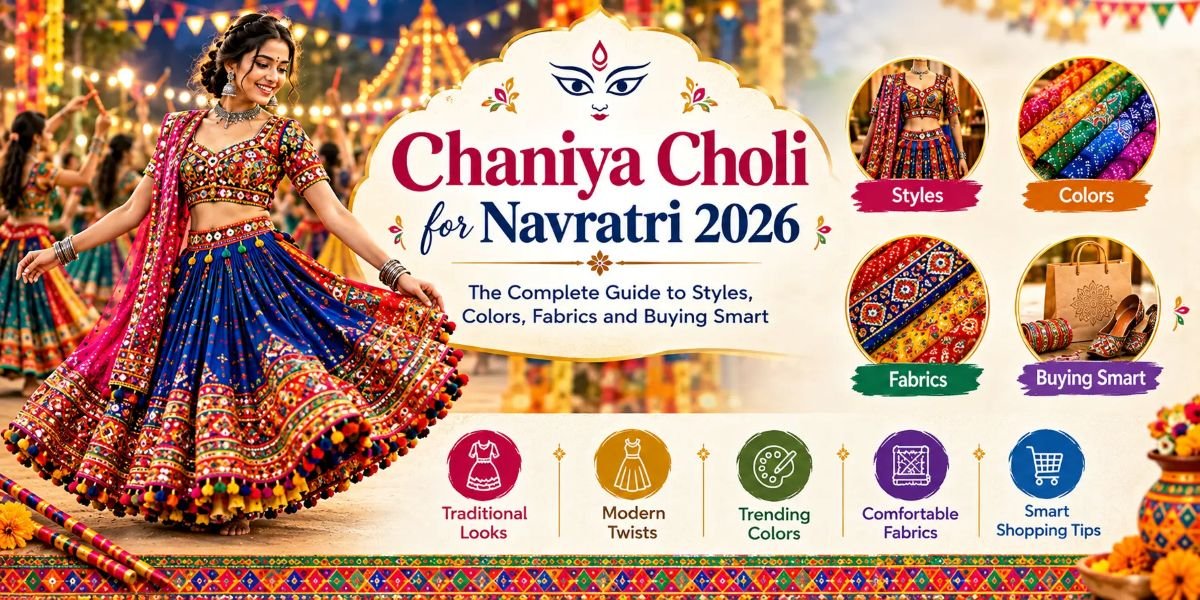
Why the Chaniya Choli Is the Heart of Navratri
If Navratri has a visual identity, it is the swirl of a chaniya choli under the lights of a garba ground. The nine nights dedicated to Goddess Durga are celebrated across India and by the Indian diaspora with devotion, fasting, music and dance, and nowhere is the celebration more colourful than in Gujarat, where garba and dandiya raas fill open grounds, society compounds and community halls after sunset. The outfit worn for these nights is not just clothing. It is part of the ritual, part of the performance and part of the memory.
A chaniya choli is a three-piece ensemble: a richly worked, flared skirt (the chaniya or ghagra), a fitted blouse (the choli) and a dupatta. The skirt is cut with generous volume so that it opens like a flower when the dancer turns. The choli is often decorated with mirror work, embroidery or patchwork. The dupatta, draped in one of several ways, finishes the look. Together they make an outfit that is built for movement, which is exactly why it has remained the unchallenged garment of garba for generations.
People search for “chaniya choli for Navratri” for many reasons. Some are first-time buyers in their teens who want a look that photographs well. Some are mothers shopping for daughters. Some are working professionals who need an outfit that survives nine evenings of dancing after a full day at the office. Some live abroad and want something authentic. And some simply want to refresh a wardrobe they have been wearing for years. This guide is written for all of them.
By the end, you will know:
- the dates and day-wise colours for Navratri 2026;
- the difference between traditional Gujarati, Rajasthani and fusion chaniya cholis;
- which fabrics and embroidery suit hot, humid, dance-heavy evenings;
- how to match the outfit to your body type, height and comfort needs;
- what you should realistically spend, and how to decide between buying, renting and custom stitching;
- how to accessorise without overloading yourself;
- how to look after the outfit so it lasts beyond one festival.
Navratri 2026 at a Glance: Dates and the Nine Colours
Planning begins with the calendar. According to published festival calendars, Sharad Navratri in 2026 begins on Sunday, 11 October 2026 with Ghatasthapana and runs through Maha Navami on Monday, 19 October, with Vijayadashami (Dussehra) following on Tuesday, 20 October. Because the festival starts on a Sunday this year, the colour sequence opens with orange.
A widely followed day-wise colour list for 2026 is:
| Day | Date | Colour | Goddess form worshipped |
|---|---|---|---|
| 1 | Sun, 11 Oct | Orange | Maa Shailputri |
| 2 | Mon, 12 Oct | White | Maa Brahmacharini |
| 3 | Tue, 13 Oct | Red | Maa Chandraghanta |
| 4 | Wed, 14 Oct | Royal Blue | Maa Kushmanda |
| 5 | Thu, 15 Oct | Yellow | Maa Skandamata |
| 6 | Fri, 16 Oct | Green | Maa Katyayani |
| 7 | Sat, 17 Oct | Grey | Maa Kalaratri |
| 8 | Sun, 18 Oct | Purple | Maa Mahagauri |
| 9 | Mon, 19 Oct | Peacock Green | Maa Siddhidatri |
A note on accuracy: Colour customs are tradition-based and not identical everywhere. Most calendars assign colours by the weekday on which each Navratri day falls, and a few sources publish slightly different sequences, especially for days seven to nine, or where a tithi is merged or skipped. Some communities, families and garba organisers do not follow a colour code at all. If you are attending a ground with a dress code, check with the organisers. If you simply want to follow the popular list above, you are on safe ground.
What Exactly Is a Chaniya Choli? The Anatomy of the Outfit
Before comparing styles, it helps to understand each part, because a good outfit succeeds or fails on how these pieces work together.
The Chaniya (Skirt)
The chaniya is the star. A traditional garba chaniya is a wide, many-panelled skirt, often with a flare of five to twelve metres or more at the hem. Wider flare means a more dramatic twirl, but also more weight. Many dancers prefer a medium flare that moves beautifully without feeling heavy by the fourth night. The skirt typically has a drawstring or hook closure at the waist and may be fully lined, partly lined or unlined.
Things to check on any chaniya:
- Weight: Heavy embroidery and layered panels look rich, but a skirt that weighs more than you can comfortably carry for three hours will spoil your evening.
- Hem length: It should clear the floor by about an inch while you wear your actual dance footwear, because you will step on a hem that is too long.
- Waist closure and lining: A soft inner lining or cotton waistband prevents irritation.
- Can-can or no can-can: A stiff net underlayer adds volume but also heat. Many modern garba outfits skip it.
The Choli (Blouse)
The choli sits close to the body and must allow your arms to move freely, because garba involves constant clapping, raising and swinging of arms. Traditional cholis can be short, backless with ties (dori), or have cut-sleeves with mirror work. Practical points:
- Check armhole comfort by raising your arms fully above your head in the trial.
- Choose strong, secure fastening. Back hooks and zips are neater, but ties give flexibility if your size varies.
- Padded and lined cholis are more comfortable than scratchy, unlined embroidery against skin.
The Dupatta
The dupatta is the most flexible part. Traditionally it is draped over one shoulder and pinned at the waist (the Gujarati style), or worn across the chest and tucked into the skirt. For long dance sessions, a lighter net, georgette or chiffon dupatta is far easier to manage than a heavy brocade. Always pin it securely, as a loose dupatta is a trip hazard in a crowded circle.
Traditional vs Modern: Chaniya Choli Styles to Choose From
Styles have multiplied in recent years. Here are the main families you will see in shops, markets and online stores.
1. Traditional Gujarati Chaniya Choli
This is the original garba look. It typically features bright, saturated colours such as red, maroon, black, indigo and mustard, combined with mirror work (abhla), bandhani (tie-dye), patchwork, beadwork and thick contrast borders. Black with multicoloured embroidery is an enduring favourite. The blouse is often a kediyu-inspired cut or a short, heavily worked choli. If you want an authentic experience, this style makes you look as though you belong on the ground.
Best for: purists, families who wear matching outfits, photographers who love texture.
2. Rajasthani and Kutchi-Inspired Styles
Kutch embroidery, with its geometric stitchwork and tiny mirrors, is among the most admired regional crafts in India. Rajasthani styles, on the other hand, lean towards gota-patti, leheriya and block prints. Both traditions have strongly influenced Navratri fashion. Kutchi-inspired chaniya cholis are popular because the handwork is distinctive and every piece looks different.
Best for: those who want a heritage look with visible craftsmanship.
3. Bandhani and Leheriya Chaniya Choli
Bandhani is created by tying tiny sections of fabric before dyeing, and leheriya produces diagonal wave patterns. Both are lighter and cooler than heavily embroidered outfits, which makes them ideal for humid evenings. A bandhani dupatta over a plain or lightly worked skirt is also a smart way to build multiple looks.
Best for: warm weather, mid-range budgets, mixing and matching.
4. Embroidered Velvet or Silk Chaniya Choli
These are richer, heavier and more suited to evenings with cooler weather or for photo-first events where the outfit is worn for a shorter time. Velvet is gorgeous but warm, so consider it mainly for locations and weather where it will not leave you overheated.
Best for: cooler regions, special nights like Ashtami or the final night, wedding-season reuse.
5. Indo-Western and Fusion Chaniya Choli
Fusion styles include crop-top cholis with a long jacket, off-shoulder or one-shoulder blouses, asymmetric hems, ruffled dupattas, belt-worn dupattas, and even pants or palazzos paired with a Navratri blouse. These are popular with younger dancers who want something photogenic and easy to move in.
Best for: college events, corporate garba nights, social media-friendly looks.
6. Lightweight Cotton and Mul Chaniya Choli
Handblock-printed cotton and soft mul-cotton are comfortable, breathable and economical. They are an excellent practical choice for the first few nights when you do not want to spend a great deal and want to dance freely.
Best for: students, beginners, large groups, practice sessions.
7. Ready-to-Wear Draped and Pre-Stitched Sets
A new category in recent seasons is the pre-stitched, ready-to-wear set where the dupatta is already pleated or attached. These are quick to wear, safer in crowds and attractive for those who are not confident about draping.
Best for: busy professionals, travellers, anyone who dislikes safety-pin adjustments.
Day-by-Day Outfit Ideas for All Nine Nights
This section turns the colour calendar into practical looks. Use it as a menu, not a rulebook.
Day 1 (Sun, 11 Oct): Orange
Orange is bright and optimistic, a perfect opener. A marigold or saffron-toned chaniya with a contrast navy or teal dupatta looks striking. For a subtle approach, try an off-white skirt with an orange bandhani dupatta. Pair with oxidised silver or antique gold jewellery.
Day 2 (Mon, 12 Oct): White
White or ivory is elegant and cooler to wear. Choose a white chaniya with pastel thread embroidery, gota-patti, or mirror work that catches the light. Because white shows stains easily, avoid heavy food near the outfit and pack wet wipes. Silver jewellery and pearls complement white beautifully.
Day 3 (Tue, 13 Oct): Red
Red is a classic Navratri colour associated with strength and energy. A deep red chaniya with gold embroidery is the traditional choice. If you wore a lot of red at last year’s festival, switch to a maroon skirt with a bright pink or orange dupatta for freshness.
Day 4 (Wed, 14 Oct): Royal Blue
Royal blue photographs superbly under evening lights. Pair it with silver or white-gold tones, or go for a bold contrast with yellow or lime accents. Indigo bandhani looks wonderful here.
Day 5 (Thu, 15 Oct): Yellow
Yellow is cheerful and suits many skin tones when the shade is right. Mustard and turmeric yellows are flattering and forgiving, while lemon yellow is lively and youthful. Use a green or pink dupatta for contrast.
Day 6 (Fri, 16 Oct): Green
Bottle green, parrot green or mint all work. Combine green with a magenta, orange or gold contrast for a very Gujarati look. Green is also easy to find in affordable ready-made ranges.
Day 7 (Sat, 17 Oct): Grey
Grey is the hardest colour to style festively, which makes it the best chance for a distinctive look. Think charcoal or silver-grey with heavy mirror work, or a grey skirt lit up by a bright coral or mustard dupatta. Oxidised silver jewellery fits naturally.
Day 8 (Sun, 18 Oct): Purple
Durga Ashtami is often celebrated with special devotion, and many people dress a little more formally for this day. A purple or wine chaniya with gold work is regal. If purple is not flattering for you, use a purple dupatta or blouse.
Day 9 (Mon, 19 Oct): Peacock Green
Peacock green, a blue-green teal, is rich and dramatic. This is a good day to bring out your best outfit, since the final night is often the most crowded and the most photographed. Gold jewellery and a contrast pink or mustard dupatta complete the look.
Optional Day 10 (Tue, 20 Oct): Vijayadashami
If you celebrate Dussehra, a simple, festive silk or cotton-silk ensemble in any colour is appropriate.
Fabrics, Work and Embroidery Explained
Fabric is the most important factor in comfort. Many shoppers choose on looks alone and discover on the third night that they are hot, itchy or exhausted.
Common Fabrics
| Fabric | Feel | Best for | Watch out for |
|---|---|---|---|
| Cotton / mul-cotton | Breathable, soft | Hot, humid weather, long dancing | Can crease; may fade if cheap |
| Georgette | Light, flowy | Twirls, layered dupattas | Can slip; needs lining |
| Chanderi / cotton silk | Light shine | Elegant, mid-weight outfits | Delicate; careful washing |
| Silk / art silk | Rich look | Special nights, photos | Warm, can be heavy |
| Velvet | Plush, heavy | Cooler regions, formal nights | Hot to dance in for long |
| Net | Airy, structured | Dupattas, overlays | Snags easily |
| Rayon / viscose blends | Soft, affordable | Casual, budget outfits | Check shrinkage |
Work and Embroidery
- Mirror work (abhla or shisha): Small mirrors stitched into fabric that glitter under lights. Look for firmly stitched mirrors on the inside and outside edges, because loose mirrors fall off and can scratch.
- Gota-patti: Applique work with metallic ribbons, usually lighter than heavy zari.
- Zari and zardozi: Metallic thread embroidery, rich but sometimes heavy and scratchy.
- Thread embroidery: Soft, colourful, usually more comfortable on skin.
- Patchwork: Mixed fabric pieces stitched into patterns, common in Kutchi and Rajasthani garments.
- Bandhani and leheriya: Dyed patterns, light and breathable.
- Block print: Pattern pressed using carved wooden blocks, economical and comfortable.
- Sequins and beadwork: Sparkly, but heavy and prone to shedding.
How to Check Quality in Two Minutes
- Turn the skirt inside out: Neat finishing and clean seam allowances signal quality.
- Run your hand over the embroidery on the inside: It should not scratch.
- Tug gently at mirrors and beads: Anything that comes off in the shop will certainly come off in the dance.
- Hold the colour against a white cloth with a drop of water: Dye that bleeds easily will damage other garments.
- Check the waist and hem: Sturdy drawstrings and clean hems last longer.
- Lift the skirt: If it feels exhausting in your hands, it will be exhausting on your waist.
How to Choose the Right Chaniya Choli for Your Body Type
There are no rules about who can wear what, but a few principles help many people feel more comfortable and confident.
Petite Frames
Very wide, heavy skirts can overwhelm a short frame. Choose a medium flare, vertical patterns or a border that is not too deep, and keep the dupatta light. A slightly higher waist can lengthen the legs.
Tall Frames
Tall dancers can carry bold prints, wide borders and dramatic flares beautifully. Make sure the hem length is right, because standard ready-made lengths may be short for you.
Curvy and Plus-Size Frames
Choose structured but breathable fabrics, a well-fitted choli with proper support and a skirt with a comfortable, wide waistband. A flowing, lightly gathered skirt is more flattering and more comfortable than a very stiff one. Avoid scratchy, unlined embroidery near the underarms. A tailor-made choli usually gives the best fit.
Athletic or Straight Frames
Volume at the skirt, a peplum or embellished blouse and a draped dupatta add shape. Contrasting borders and layered dupattas help.
Pear-Shaped and Apple-Shaped Frames
For a pear shape, emphasise the upper half with a richly worked blouse and keep the skirt simpler. For an apple shape, an empire-style or well-defined waist, with a flowing skirt and V-neck choli, gives balance and comfort.
Skin Tone and Colour
Colour choices are personal, but as a rough guide: warmer undertones often glow in mustard, orange, olive, maroon and gold. Cooler undertones often suit royal blue, emerald, plum and silver. Deeper skin tones glow in jewel tones and bright whites. Fairer skin tones suit deep greens, wine and rich blues. The strongest advice remains: wear the colour that makes you happy.
Budget Guide: What to Expect at Every Price Point
Prices vary by city, brand, craftsmanship and season, and they rise sharply in the weeks before Navratri. The ranges below are broad, indicative estimates in Indian rupees to help you plan, not fixed prices. Always compare current listings.
Under about ₹2,500: Practical and Printed
Expect cotton or rayon blends, block prints, light embroidery and machine-made work. These sets are comfortable, easy to find and good for casual evenings, practice sessions and kids. Quality varies a lot, so check stitching and colour fastness.
About ₹2,500 to ₹6,000: The Sweet Spot
This range usually offers better fabric, more detailed embroidery, mirror work and cleaner finishing. It is where most buyers find an attractive balance between look and cost. Many brands and local shops offer ready-made sets with lined cholis and matching dupattas here.
About ₹6,000 to ₹15,000: Premium Craftsmanship
This range often includes richer silks, heavier embroidery, designer-inspired cuts and partly handcrafted work. If you plan to reuse the lehenga for weddings or festive events, this segment can be a good investment.
Above about ₹15,000: Designer and Handcrafted
Handcrafted heirloom pieces, designer labels and custom couture sit here. They are beautiful, but for nine nights of vigorous dancing, make sure you are comfortable with the risk of sweat, wear and tear.
Hidden Costs to Remember
- Blouse alterations or tailoring
- Can-can or petticoat
- Matching jewellery and footwear
- Dry cleaning after each wear
- Express delivery charges
- Safety pins, hooks, and a small repair kit
Buy, Rent or Stitch? Making the Smart Choice
Three routes lead to a Navratri outfit, and each suits a different situation.
Buying Ready-Made
Pros: instant availability, easy comparison, wide range of price points, returns on many online platforms. Cons: standard sizing may need alterations, popular designs sell out, and you may meet someone wearing the same outfit.
Best for: shoppers who can try on in person, or who are ordering from a platform with a clear return and exchange policy.
Renting
Rental has become popular in big cities because garba outfits are often worn only a few times. Renting gives access to heavier, more expensive designs for a fraction of the cost.
Pros: lower cost, variety across nights, no storage worries. Cons: limited sizes in peak weeks, security deposits, strict return dates, and the risk of damage charges for stains or torn mirrors.
Best for: visitors, students, people who want a different look each night, and anyone who will not reuse the outfit.
Questions to ask a rental shop: What is the deposit and when is it refunded? Is dry cleaning included? What counts as damage? Can I alter the fit? What happens if the outfit is returned a day late?
Custom Stitching
A tailor can cut a choli exactly to your measurements, adjust the flare of the skirt and let you choose every fabric and border. It is the best route for fit and comfort, especially for plus-size, petite or very tall dancers.
Pros: perfect fit, personal design, comfort-focused choices. Cons: needs lead time (often two to four weeks in festival season), costs can climb, and delays are common near the festival.
Best for: people with specific fit needs, or those who want a one-of-a-kind outfit.
A Simple Decision Guide
| Your situation | Suggested route |
|---|---|
| Less than a week to Navratri | Ready-made or rental |
| Want to reuse for weddings and events | Buy or custom stitch |
| Need a different outfit each night | Rent, or mix-and-match capsule |
| Difficult to find your size | Custom stitch the choli, buy the skirt |
| Tight budget | Cotton ready-made plus dupatta swaps |
| Travelling abroad for the festival | Buy ready-made in advance, or rent locally |
Accessories, Jewellery, Footwear, Hair and Makeup
Accessories are where a good outfit becomes a memorable one, and also where comfort often gets forgotten.
Jewellery
Traditional garba jewellery leans towards oxidised silver and antique gold, and the look is often bold and layered.
- Necklaces: Choker or collar-style necklaces suit open necklines. Long haars work with high necklines.
- Earrings: Large jhumkas and chandbalis are classics, but very heavy earrings become painful after an hour of dancing. Choose lightweight versions, or clip-on styles with soft padding.
- Maang tikka and matha patti: Beautiful, but secure them firmly with pins.
- Bangles and kadas: Stacks of bangles produce a rhythmic jingle that is part of the garba sound. Wear what is comfortable, and avoid sharp edges that can scratch your neighbour in a circle.
- Waist belt (kamarbandh): Holds the dupatta in place and defines the waist. A well-fitted belt helps keep the skirt secure.
- Anklets (payal): Add rhythm. Test them at home to make sure they do not catch your hem.
- Nose ring: Optional, and often an easy way to add a festive touch.
Tip: If you are travelling, oxidised and imitation jewellery is practical because it is light, affordable and low risk if misplaced.
Footwear
This is the most underrated decision of Navratri. Most garba grounds are open, uneven and crowded, and people accidentally step on each other’s feet.
- Choose flat, cushioned and closed or secure footwear. Many dancers prefer sneakers, ballet flats or sturdy flat sandals with a back strap.
- Some dancers choose to dance barefoot where the ground is clean and permitted, so check the venue’s rules.
- Avoid heels, thin wedges and brand-new shoes that have not been broken in.
- Decorate plain footwear with fabric or mirror-work covers if you want the festive look without sacrificing comfort.
Hair
Garba involves spinning, so style your hair to survive.
- Braids (including side braids and fishtail braids), decorated with flowers or parandis, are traditional and stay secure.
- Buns with gajra (floral strings) look elegant and keep hair off the neck.
- High ponytails and half-up styles with decorative clips are popular with younger dancers.
- Use plenty of pins and a light-hold spray, because loose hair sticks to a sweaty face and neck.
Makeup
Plan for heat and sweat.
- Start with a light, long-wear base and a good primer.
- Use waterproof or smudge-proof eye products, since eyeliner (especially a bold winged liner or kohl) is a signature Navratri look.
- Use cream blush and highlighter, which blend into skin and last longer than powder in humid weather.
- Choose a long-wear lip colour in a shade that matches the day’s outfit, and carry a mini lip balm.
- Add a small bindi or decorative face gems if you like. Make sure adhesives are skin-safe, and patch-test new products before the festival.
- Finish with a setting spray.
Dancing Comfort: How to Garba for Hours Without Trouble
A beautiful chaniya choli should never be the reason you leave the circle early. These practical steps come from common experience among regular dancers and are worth following.
- Do a full-motion test at home: Wear the complete outfit, including footwear, and dance for fifteen minutes. Raise your arms, spin, bend, clap and sit. If anything pinches, slips or itches, fix it before the festival.
- Manage the waist: The skirt waistband carries the weight of the entire outfit. A wide, soft waistband and a properly tied drawstring spread the load. A belt over the waist can help.
- Pin the dupatta in three places: Secure it on the shoulder, at the waist and near the elbow side if it hangs long. This avoids the scramble to re-drape mid-song.
- Hydrate and fuel up sensibly: Many people fast during Navratri. If you are fasting, discuss with a doctor if you have any health condition, and do not dance intensely on an empty stomach. Carry water, nuts or dates and take breaks.
- Carry a mini kit: Safety pins, a hair elastic, a small sewing kit, tissues, a lip balm, a compact mirror, a few plasters for blisters and a small deodorant or powder.
- Protect your skin: Cotton inner layers and a soft camisole under heavily embroidered cholis can prevent chafing. Apply anti-chafe balm where fabric rubs.
- Watch your surroundings: Crowded circles can get chaotic. Keep your skirt gathered when moving through crowds, and maintain safe distance from fast dandiya sticks.
- Know when to rest: Nine nights is a marathon. Rotate lighter and heavier outfits across the festival and give your feet and back time to recover.
Chaniya Choli for Kids, Men and Plus-Size Dancers
Navratri belongs to everyone, and the outfit choices expand beyond adult women’s lehenga cholis.
Kids and Teens
Children love Navratri, but they also grow quickly and play hard. Practical advice:
- Choose cotton or soft blends with a soft lining.
- Avoid heavy mirror work or scratchy zari on young skin.
- Pick a size with a little room, but not so loose that the skirt trips them.
- Pre-stitched dupattas or attached dupatta styles are safer for small dancers.
- Prefer secure waist closures with elastic backing for comfort.
- Check that mirrors and beads are firmly stitched so they are not a choking risk for very young children.
Matching family outfits (twinning) are a fun trend, and a coordinated colour scheme often looks better than exact matching.
Men
While this guide focuses on chaniya choli, men typically wear a kediyu (a flared, short kurta with a gathered or pleated waist), paired with a dhoti-style bottom or churidar, plus a turban or safa. Embroidered and mirror-work kediyus match the women’s chaniya cholis and make coordinated couples’ and family looks easy.
Plus-Size Dancers
Good fit matters more than anything else. Look for:
- brands and tailors that offer extended sizing in cholis (and ideally adjustable-tie backs);
- a lined choli with adequate side and underarm support;
- skirts with lightweight flare rather than very stiff layers;
- fabrics that breathe, such as cotton, mul and georgette;
- a longer dupatta draped diagonally for comfort and confidence.
No one should feel excluded from the garba circle because of size, and more labels are catering to a wider range of bodies than before.
Maternity and Mobility Considerations
Expecting mothers and those with mobility needs can still enjoy the festival. Choose a loose, empire-style choli and a lightweight skirt, wear secure flat footwear and avoid overheating. Check with your doctor about dancing and fasting during pregnancy.
Care, Storage and Reuse
A chaniya choli is an investment of money and emotion, and a few habits help it last for many seasons.
During the Festival
- Air it out after each wear, inside out, in a shaded, ventilated area.
- Spot-clean minor stains with a damp cloth, and test any product on a hidden area first.
- Use dress shields or underarm pads in the choli to protect from sweat.
- Keep perfume off the fabric, since alcohol and oils can stain.
- Fix loose mirrors and beads at once, before they become bigger problems.
After the Festival
- Dry clean heavily embroidered, silk, velvet and zari pieces. Washing at home may damage the fabric or work.
- Hand wash cotton and bandhani gently in cold water with a mild detergent, and dry in the shade. Wash dark and bright colours separately the first time, since bandhani can bleed.
- Iron on low heat on the reverse side, and never press directly on mirrors, sequins or zari.
- Store the lehenga folded loosely in a breathable cotton or muslin cover, not plastic. Refold along different lines every few months to prevent permanent creases.
- Add neem leaves or silica gel to storage to limit moisture and insects.
- Keep the dupatta and choli wrapped separately to avoid colour transfer.
Reusing and Restyling
A festival chaniya choli can live a second life:
- Wear the skirt with a plain crop top or a long kurta for a fusion outfit.
- Use the dupatta as a drape on a plain saree or with a simple kurta set.
- Convert the choli into a statement blouse for a saree.
- Rework old pieces with new borders, lace or mirrors.
- Pass it down. Many families treasure hand-embroidered chaniya cholis for generations.
Common Mistakes to Avoid
- Buying only for photos: An outfit that looks superb standing still but cannot handle spinning is the commonest regret.
- Leaving it until the last week: Prices increase and sizes sell out as the festival approaches. Order or book early.
- Ignoring the weather: Velvet in humid cities and thin fabrics in cold regions are both poor choices.
- Skipping the trial: Always do a full-motion trial, ideally with the shoes you will wear.
- Wrong hem length: Too long and you trip; too short and the look feels unfinished.
- Overloading accessories: Heavy jewellery plus heavy outfit equals fatigue by night three.
- Forgetting the blouse fit: A skirt can be adjusted with a drawstring, but a tight choli is difficult to fix at the last minute.
- Trusting only filtered product photos: Read reviews with customer photos and check return policies.
- Ignoring colour fastness: Test any new dark or bandhani piece before wearing it with light fabrics.
- Not planning for shoes: The wrong footwear can end the evening faster than any outfit problem.
- Dressing against the dress code: Some clubs and societies request specific colours or standards, so confirm in advance.
- Ignoring cultural respect: Navratri is a religious festival. Choose outfits that feel appropriate to the setting and respect the traditions of the event.
AI Styling Suggestions You Can Try
Artificial intelligence tools can be useful planning companions for Navratri shopping, as long as you treat them as assistants and not authorities. Here are practical ways to use them, along with sample prompts.
1. Build a Nine-Day Plan
Sample prompt: “Create a nine-day Navratri 2026 outfit plan using only three chaniya skirts and five dupattas, with the day-wise colours orange, white, red, royal blue, yellow, green, grey, purple and peacock green. My budget is ₹10,000.”
2. Compare Shopping Options
Sample prompt: “I am 5’3″, curvy, and will dance for three hours each night in humid weather. Suggest fabrics and silhouettes that suit me, and list five questions I should ask the seller.”
3. Colour Matching
Sample prompt: “I have a mustard skirt. Suggest five dupatta and blouse colour combinations for a traditional look and five for a modern look.”
4. Accessory Pairing
Sample prompt: “Suggest lightweight jewellery and hairstyles to go with a black chaniya choli with multicoloured mirror work.”
5. Budget Tracking
Sample prompt: “Create a simple table to track my Navratri spending across outfit, accessories, tailoring and care.”
What AI Cannot Do
AI suggestions are limited in important ways:
- They cannot feel the fabric, so they cannot judge comfort or itchiness.
- They may rely on outdated or generic information about prices, availability or trends.
- They cannot verify the quality of a particular seller.
- Colour guidance can differ across communities, so confirm with your family, society or garba organisers.
- They cannot replace a tailor’s measuring tape.
For important purchases, verify dates, prices, return policies and reviews on the seller’s own website or in person.
Frequently Asked Questions
What is a chaniya choli?
A chaniya choli is a traditional Indian outfit made up of a flared skirt (chaniya or ghagra), a fitted blouse (choli) and a dupatta. It is especially associated with Gujarat and Rajasthan and is the classic garment for garba and dandiya during Navratri.
When is Navratri 2026?
Sharad Navratri 2026 begins on Sunday, 11 October, and ends with Maha Navami on Monday, 19 October. Vijayadashami (Dussehra) follows on Tuesday, 20 October. Local calendars can differ slightly depending on tithi calculations, so check with your local temple or community.
What are the Navratri colours for 2026?
A widely published sequence is orange, white, red, royal blue, yellow, green, grey, purple and peacock green for days one to nine. Colour practices vary by community, and some groups do not follow a colour code at all.
Which colour chaniya choli is best for Navratri?
There is no single best colour. Red, maroon, black, royal blue, mustard and green are all popular. The best choice is one that suits the day, the venue and your own comfort and style.
Is it better to buy or rent a chaniya choli?
Buy if you will reuse it for weddings and other occasions. Rent if you want a different outfit each night, have a limited budget or will not wear it again.
How much should I spend on a chaniya choli for Navratri?
Indicative ranges run from under ₹2,500 for simple printed sets to ₹15,000 and above for designer and handcrafted pieces. Many buyers find the ₹2,500 to ₹6,000 range offers good value. Compare current prices, because they vary by city and season.
Which fabric is best for garba?
Cotton, mul-cotton, georgette and light cotton-silk are comfortable for long dancing. Velvet and heavy silk are better for cooler weather or short wear.
What footwear should I wear with a chaniya choli?
Flat, cushioned and secure footwear such as sneakers, flat sandals with straps or ballet flats. Avoid heels, and check whether the venue allows barefoot dancing.
How do I stop my dupatta from slipping while dancing?
Pin it at the shoulder and waist, use a lightweight fabric such as net or georgette, and consider a pre-stitched or belt-secured dupatta style.
How do I clean a chaniya choli with mirror work?
Dry clean heavily embellished, silk and zari pieces. Hand wash lightweight cotton gently in cold water, dry in the shade and never wring mirror work.
Can I wear a chaniya choli again after Navratri?
Yes. Reuse the skirt with a plain top, repurpose the dupatta with sarees and kurtas, or wear the full outfit for weddings and festive occasions.
Is it okay to wear a fusion chaniya choli to garba?
Yes, in most places. Fusion styles are widely popular. If your venue or community has a traditional dress code, check with the organisers.
What should kids wear for Navratri?
Soft cotton or light blended chaniya cholis with secure closures and minimal scratchy embroidery. Prioritise comfort and ease of movement.
How early should I order or book a chaniya choli?
Ideally three to four weeks before the festival for custom stitching, and at least one to two weeks before for ready-made and rental, since popular sizes sell out.
Can AI help me choose a chaniya choli?
AI tools can help you plan colours, budget and combinations, and generate questions to ask a seller. They cannot check fabric quality or fit, so use them for planning and verify details yourself.
Final Thoughts
The best chaniya choli for Navratri is not necessarily the most expensive, the most embroidered or the most photographed. It is the one that lets you dance with joy for hours, honours the spirit of the festival and makes you feel like yourself. Start with the calendar and the colour list, choose fabrics that suit your climate and your stamina, invest in fit, plan your accessories and footwear around comfort, and treat the outfit with care so it can return, season after season.
With Navratri 2026 beginning on 11 October, there is still time to plan. If you are shopping this week, prioritise availability and fit: ready-made sets and rentals can be secured quickly, while custom stitching may already be tight on time. Whichever route you choose, remember that garba is about community, rhythm and devotion, and the outfit is simply the frame for the celebration.
