

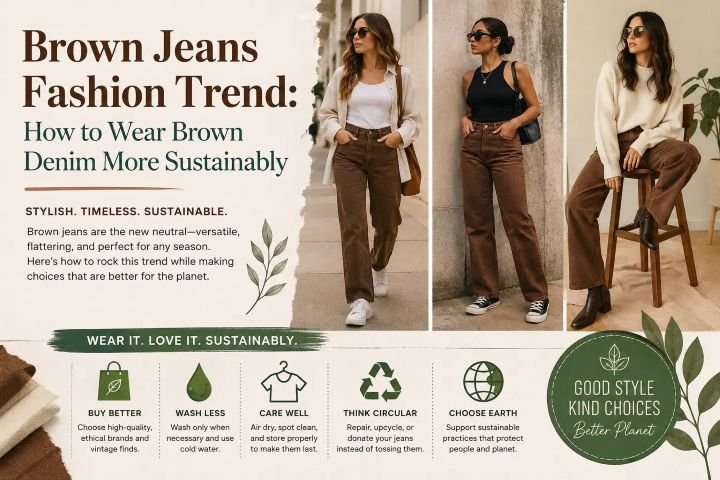
Blue denim has ruled our closets for over a century, but 2026 belongs to a different shade entirely. From runway shows to street style feeds, the brown jeans fashion trend has quietly become one of the most talked-about shifts in modern denim. Chocolate, espresso, cognac, and carob washes are replacing indigo as the neutral of choice for people who want their wardrobe to feel warmer, more grounded, and just a little more elevated than the usual blue-on-blue uniform.
But there’s a second story unfolding alongside this color shift, and it matters just as much: the growing demand for sustainable jeans. As shoppers fall for brown denim, many are also asking harder questions about how their clothes are made — the water used to grow the cotton, the chemicals used to dye and finish the fabric, and the labor behind every stitch. This piece is a deep dive into both threads at once. We’ll unpack why brown denim is having a moment, then walk through exactly how to build a brown jeans wardrobe that’s kinder to the planet, using eco-friendly denim, ethical denim practices, and the principles of slow fashion.
Whether you’re brown-denim-curious or already several pairs deep, this guide will help you shop smarter, style better, and wear your jeans for years instead of seasons.
Table of Contents
- Why Brown Jeans Are 2026’s Breakout Denim Trend
- A Brief History of Brown Denim
- The Environmental Cost of Conventional Denim
- What Makes Denim “Sustainable”?
- Why Brown Denim and Sustainability Are a Natural Pair
- How to Identify Genuinely Eco-Friendly Denim
- Ethical Denim Brands and Practices Worth Knowing
- Slow Fashion Principles for Building a Brown Jeans Wardrobe
- How to Style Brown Jeans: Silhouettes, Fits, and Outfit Formulas
- Caring for Your Brown Jeans So They Last
- Common Mistakes to Avoid When Buying Sustainable Brown Jeans
- Frequently Asked Questions
- Final Thoughts
1. Why Brown Jeans Are 2026’s Breakout Denim Trend
If you’ve scrolled through a fashion feed lately, you’ve probably noticed it: jeans that are unmistakably brown, not blue, not black, styled with the same confidence people once reserved for their favorite indigo pair. This isn’t a fluke of the algorithm. Industry insiders and designers are backing it up in real time.
At Ossou, co-creative director Nina Khosla has been vocal about the shift toward brown as a way to create a new neutral palette, describing brown denim used monochromatically as feeling raw and fresh, and less expected than camel, with a bit of edge. Citizens of Humanity’s creative director Marianne McDonald has echoed that sentiment, noting that brown has become a key color in the brand’s collection this season for its richness.
So why now? A few forces are converging:
- A reaction to a decade of cool tones: Wardrobes have leaned heavily on bright whites, cool grays, and classic blue denim for years. Brown feels like a deliberate pivot toward warmth.
- The “quiet luxury” hangover: After several seasons of minimalist, logo-free dressing, brown denim reads as the natural extension of that restrained, elevated aesthetic — sophisticated without shouting.
- Versatility: Brown pairs with nearly every other color in a typical closet — cream, white, black, navy, olive, and even bold jewel tones — which makes it an easy sell for shoppers who already own the basics.
- A sense of longevity: Unlike micro-trends that vanish in a single season, brown denim is being marketed and perceived as an investment piece, something that will still look intentional two or three years from now.
2. A Brief History of Brown Denim
Brown denim isn’t actually new — it’s a revival. Before indigo became the default, workwear and utility garments were dyed in whatever was practical and available, and earthy browns, tans, and khakis were common in mid-century American workwear, military surplus, and outdoor gear. Brown corduroy and brown twill trousers have cycled in and out of fashion for decades, often tied to a “back to basics” or heritage-inspired mood.
What’s different this time is context. Brown denim’s return in 2026 is arriving alongside a broader earth-tone movement across fashion — think terracotta, olive, camel, and rust — and alongside a consumer base that is more conscious of sustainability than any previous generation of shoppers. That combination is why brown jeans are being framed not just as a color trend, but as part of a values-driven shift in how people want to build their wardrobes.
3. The Environmental Cost of Conventional Denim
To understand why sustainability conversations are attaching themselves so tightly to the brown denim moment, it helps to understand what conventional denim production actually costs the planet.
Denim is a genuinely resource-intensive fabric. In 2026, fashion remains one of the top five polluting industries, with denim manufacturing responsible for a sizable share of that pollution. The biggest culprit is water. Water is used at nearly every stage of denim production, and growing the cotton itself is enormously thirsty — it can take up to 1,000 gallons of water to produce just one pound of cotton, and a single pair of men’s jeans contains roughly 1.5 pounds of cotton, which works out to around 1,500 gallons of water for the raw material alone.
Then there’s the afterlife of the garment. Cheaply made jeans tend to fall apart quickly, encouraging a buy-and-discard cycle that fills landfills with textile waste and keeps demand for new virgin cotton — and all the water and chemicals that come with it — artificially high.
4. What Makes Denim “Sustainable”?
Sustainable jeans is a phrase that gets used loosely, so it’s worth breaking down what actually separates eco-friendly denim from a marketing label. Genuinely sustainable denim production tends to prioritize the following:
- Eco-friendly fibers: Rather than relying solely on conventional virgin cotton, sustainable brands increasingly turn to organic cotton, recycled cotton, hemp, Tencel, and other sustainable fibers. Organic cotton is grown without synthetic pesticides and fertilizers, recycled cotton reduces demand for new raw material, and fibers like hemp and Tencel typically require far less water to produce.
- Water conservation technology: Forward-thinking mills are investing in water-saving technologies like laser finishing, air dyeing, and closed-loop water recycling systems. Some facilities have gone even further, installing Zero-Liquid Discharge systems that purify, recycle, and reuse up to 95 percent of industrial wastewater on-site.
- Cleaner dyeing methods: A wave of newer dyeing techniques is replacing the most toxic conventional processes. Research on denim sustainability points to digital spray, foam dyeing, dope dyeing, and supercritical CO2 dyeing as promising alternatives to conventional dyeing techniques, along with indigo produced from bacteria and microbially assisted dyeing processes.
- Chemical-free or low-impact processing: This means avoiding harmful chemicals in dyeing and finishing in favor of natural dyes and safer alternatives wherever possible.
- Fair labor practices: Sustainability isn’t only environmental. Ethical denim production also requires safe working conditions and fair wages for the garment workers who cut, sew, and finish every pair of jeans.
5. Why Brown Denim and Sustainability Are a Natural Pair
Brown denim and sustainable fashion aren’t connected by accident — there are a few genuine reasons the two trends reinforce each other.
- Earth tones photograph as “considered,” not disposable: Part of the appeal of brown jeans is that they read as intentional rather than trend-chasing. That perception dovetails naturally with slow fashion, which prizes pieces bought to be worn for years, not one season.
- Brown hides wear differently than indigo: Traditional blue jeans are often prized precisely for how they fade — but that fading is usually the result of aggressive chemical or mechanical distressing during manufacturing.
- Natural dye compatibility: Brown is one of the easier colors to achieve using plant-based and low-impact dye methods — think walnut hulls, tea, madder root, and other tannin-rich natural dyes — compared to synthesizing a perfectly saturated indigo blue.
- The “one neutral to rule them all” argument: A well-made pair of brown jeans can replace several pairs of trend-driven jeans in different washes, because it pairs with so much of what’s already in a typical closet.
6. How to Identify Genuinely Eco-Friendly Denim
Sustainability claims are easy to make and hard to verify from the outside, so here’s a practical checklist for shopping brown jeans (or any jeans) with real eco-credentials.
- Check the fiber content: Look for organic cotton, recycled cotton, hemp blends, Tencel/Lyocell, or a combination. A tag that simply says “100% cotton” with no further detail tells you nothing about how it was grown.
- Look for third-party certifications: Certifications like GOTS (Global Organic Textile Standard), OEKO-TEX, Fair Trade Certified, and Bluesign indicate an independent body has verified specific claims about the fiber, dye process, or labor conditions — rather than the brand simply asserting it.
- Read the finishing description: Brands that use laser fading, ozone fading, or enzyme washes instead of traditional stone-washing or sandblasting will often mention it directly, because it’s a meaningful selling point. If a product page is silent on how the wash or distressing was achieved, that’s worth a direct question to customer service.
- Ask about water usage: Some brands now publish liters-of-water-per-garment figures. A brand willing to share that number, even an imperfect one, is generally more transparent than one that avoids the topic entirely.
- Look at construction quality, not just materials: Sustainability includes longevity. Reinforced stitching, quality hardware, and a fit that will still feel relevant in a few years all reduce the odds you’ll replace the jeans after one season — which matters just as much as the fiber content.
7. Ethical Denim Brands and Practices Worth Knowing
You don’t need brand-specific endorsements to shop well — the principles above will serve you at almost any retailer — but it helps to know what kinds of companies tend to lead on ethical denim practices, so you know what to look for when researching a specific label:
- Vertically integrated mills and manufacturers that control the process from raw fiber to finished garment tend to have more transparency and more ability to implement water recycling and cleaner dyeing at scale, since they’re not relying on a patchwork of subcontractors.
- Denim-focused sustainability initiatives and mills — the kind of specialist fabric producers that supply many different clothing brands — are often where the real innovation happens, since they can invest heavily in dyeing and finishing R&D and spread that cost across many clients.
- Smaller, direct-to-consumer denim labels frequently lean into slow fashion positioning: limited runs, made-to-order production, repair programs, and take-back schemes that keep old jeans out of landfill.
- Resale and rental platforms specifically for denim have grown alongside the broader secondhand fashion boom, giving shoppers a lower-impact way to try the brown denim trend without buying new.
When researching any specific brand, look past the marketing copy on the homepage and check for a dedicated sustainability or impact page with real data. If a brand can’t point to specifics — certifications, water figures, factory locations, labor audits — treat “sustainable” as a claim rather than a fact.
8. Slow Fashion Principles for Building a Brown Jeans Wardrobe
Slow fashion is less about a specific shopping list and more about a mindset shift. Here’s how to apply it specifically to the brown denim trend, so the pieces you buy actually last.
- Buy fewer, better pairs: Instead of picking up three cheap brown jeans in slightly different washes, invest in one or two well-made pairs that fit properly and are constructed to last years, not months.
- Prioritize fit over fad: Because brown is being shown across so many silhouettes right now — wide-leg, straight, slim, barrel — it’s tempting to chase whichever shape is trending hardest. Choose the cut that actually flatters your body and that you’ll want to wear in three years, not just this season.
- Repair before you replace: A loose hem, a popped button, or a small tear is rarely a reason to discard a pair of jeans. Many tailors and cobblers can mend denim cheaply, and some brands offer their own repair services.
- Rewear intentionally: Slow fashion isn’t about wearing something once and photographing it — it’s about building outfits you’ll return to. Brown denim’s neutral quality makes this easy, since a single pair can anchor dozens of different outfits across seasons.
- Resell or hand down what you no longer wear: When a pair genuinely no longer fits your life, resale platforms and consignment keep it in circulation rather than in a landfill.
- Slow down the buying decision itself: Before purchasing a new pair, give it a day or two. Trend pieces bought impulsively are the ones most likely to end up unworn within a year.
9. How to Style Brown Jeans: Silhouettes, Fits, and Outfit Formulas
Now for the fun part. Brown jeans are remarkably easy to style once you understand the color’s warmth and how it interacts with the rest of a palette.
Choosing a shade
- Chocolate and espresso brown are the most versatile, dark enough to function almost like a black or navy jean while still reading as distinctly warm and current.
- Camel and tan lean lighter and pair beautifully with crisp whites and creams for a monochromatic, elevated look.
- Rust and cognac bring more personality and work well as a statement piece against neutral tops.
Silhouettes to know
- Wide-leg and barrel-leg brown jeans are one of the defining shapes of the year. In brown, the wide leg feels less casual than the same cut in blue — pair it with a fitted, tucked-in top to balance the volume.
- Straight-leg brown jeans are the most office-appropriate option and pair easily with blazers, loafers, and button-downs.
- Slim and cigarette-leg brown jeans lean into a ’90s-inspired minimalism and work well with chunkier boots or sneakers to modernize the silhouette.
- Coated or waxed brown denim brings a subtle sheen that reads as more polished and evening-appropriate.
Outfit formulas
- For the office: A chocolate brown or camel blazer over a crisp white shirt, paired with dark brown straight-leg jeans, oxford shoes, or leather loafers.
- Smart casual: An oversized grey or navy blazer over a plain white tee, brown wide-leg jeans, and clean white sneakers or ankle boots.
- Everyday casual: A cream or off-white sweater tucked into straight-leg brown jeans, finished with suede boots or minimalist leather sneakers.
- Evening: Slim brown jeans, a black or navy fitted top, and a statement boot or heeled loafer for a look that feels dressed-up without a dress.
What pairs well with brown denim
White, cream, black, navy, olive green, beige, gray, and light blue all pair exceptionally well with brown denim, which is part of why the color has been embraced so quickly — it plugs directly into most existing wardrobes without requiring a full closet overhaul. On the footwear side, white sneakers, loafers, Chelsea boots, suede boots, and minimalist leather sneakers all work well with brown denim, and for a dressier take, dark brown denim tends to look more refined than blue jeans and pairs especially well with blazers, oxford shirts, and loafers.
Seasonal styling
- Spring: Lighter camel-toned brown jeans with a linen shirt and canvas sneakers.
- Summer: Cropped or straight brown denim with a simple tank and leather sandals.
- Fall: Chocolate or espresso brown jeans layered under an oversized knit, finished with ankle boots — arguably brown denim’s most natural season.
- Winter: Coated dark brown denim with a wool coat and leather boots for a polished cold-weather uniform.
10. Caring for Your Brown Jeans So They Last
Sustainability doesn’t end at the checkout — how you care for a garment has a real impact on its lifespan and its environmental footprint over time. A few habits go a long way:
- Wash less often: Denim doesn’t need washing after every wear. Spot-clean small stains and air out jeans between wears; this alone dramatically extends the life of the fabric and reduces water and energy use.
- Wash cold and inside out: Cold water washing protects both the fiber and the dye, helping brown denim keep its rich, even tone instead of fading unevenly or turning patchy.
- Skip the dryer when you can: Air-drying prevents the kind of shrinkage and fiber breakdown that leads to jeans wearing out faster and needing early replacement.
- Mend small issues immediately: A loose thread or small hole is a five-minute fix today and a ruined pair in six months if ignored.
- Store thoughtfully: Folding rather than constantly hanging heavy denim prevents stretching at the waistband, and keeping jeans away from direct sunlight for long periods helps prevent premature fading.
11. Common Mistakes to Avoid When Buying Sustainable Brown Jeans
- Assuming “brown” automatically means “eco-friendly:” The color has nothing to do with how the garment was produced — always check the materials and process, not just the aesthetic.
- Chasing the trend at the expense of fit: A cheaply made pair in the “right” wash will look worse and last less time than a well-fitted pair in a slightly different shade.
- Overlooking care instructions: Coated and waxed brown denim finishes often have specific care requirements — ignore them and you risk cracking or discoloring the finish prematurely.
- Buying multiples “just in case:” Because brown is trending hard right now, it’s tempting to buy several pairs across brands. Slow fashion logic suggests testing one great pair first.
- Ignoring secondhand options: With brown denim’s rising popularity, resale platforms and thrift stores are increasingly good sources — often at a fraction of the price and impact of buying new.
12. Frequently Asked Questions
Is the brown jeans trend going to last, or is it a passing fad?
Industry signals suggest staying power rather than a single-season flash. Multiple luxury houses and mainstream denim brands have built entire collections around the color, and stylists are positioning.
Are brown jeans more sustainable than blue jeans by default?
No. The color itself doesn’t determine environmental impact — the fiber sourcing, dyeing method, water usage, and labor practices behind the specific pair do.
What’s the difference between “sustainable,” “eco-friendly,” and “ethical” denim?
These terms overlap but aren’t identical. “Sustainable” and “eco-friendly” typically refer to environmental impact — water use, chemicals, and materials.
Can I make my existing blue jeans more sustainable instead of buying new brown ones?
Absolutely, and it’s often the lowest-impact choice available. Some dye kits and professional dye services can shift the color of existing denim toward brown or tan tones.
How do I know if a “natural dye” claim is legitimate?
Look for specifics: the actual dye source (walnut, madder root, tea, etc.), and ideally a certification like GOTS or OEKO-TEX that verifies the finishing process meets defined environmental standards.
Do brown jeans work for all skin tones and body types?
Yes — that’s part of the appeal. Because brown spans such a wide range from pale camel to deep espresso, there’s a shade that complements virtually any skin tone, and the silhouette options (wide-leg, straight, slim) mean the trend adapts to different body types rather than demanding one specific shape.
13. Final Thoughts
The brown jeans fashion trend is one of those rare denim moments that’s both genuinely stylish and genuinely well-timed. It’s arriving at a point when shoppers are more willing than ever to ask what’s actually behind their clothes — how they’re dyed, what they’re made from, and who made them. That makes this the perfect moment to build a brown denim wardrobe the right way: fewer pairs, better materials, cleaner production, and a plan to wear each pair for years rather than months.
You don’t have to choose between following the trend and shopping responsibly. Look for organic or recycled fibers, ask about water-saving dye techniques, favor brands that are transparent about labor practices, and don’t overlook secondhand brown denim as a genuinely great entry point. Do that, and you’ll end up with a pair — or two — of brown jeans that look as good in five years as they do today, which is really the whole point of slow fashion in the first place.

2 Comments
Pingback: Brown Jeans Fashion Trend 2026: How to Style Brown Denim
Pingback: Brown Jeans Fashion Trend: 15 Stylish Outfit Ideas for 2026