

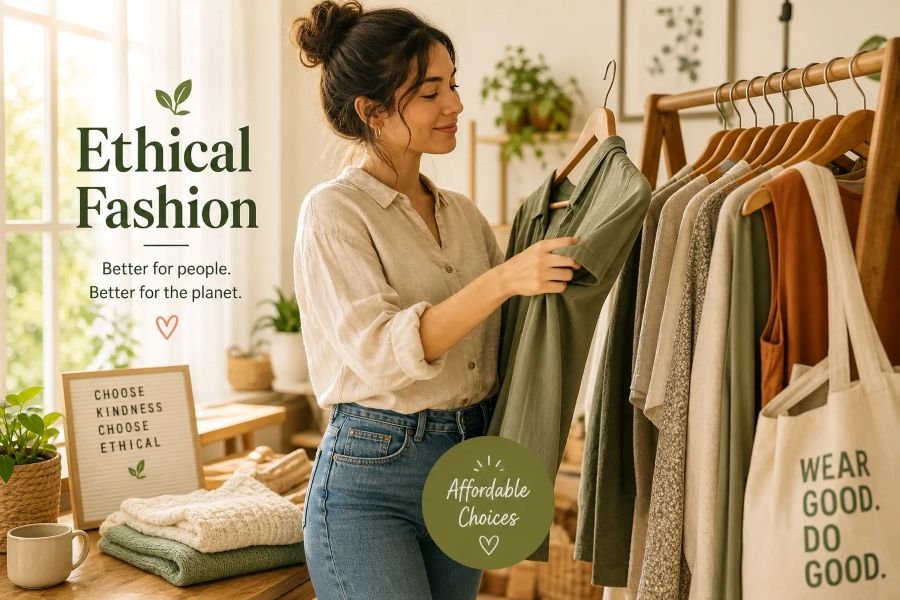
The price tag on ethical fashion has a reputation problem. Spend five minutes browsing sustainable clothing results online and you’ll find no shortage of triple-digit organic linen shirts and recycled-fiber jeans priced well above $150. That assumption, that dressing ethically requires a premium budget, has kept a lot of people on the sidelines, and understandably so. But if you’re looking for affordable ethical clothing, the good news is that gap is closing fast.
In 2026, there are genuinely good options at every price tier, from $15 organic-cotton tees to resale Patagonia gear at a fraction of retail. This guide covers 20 affordable ethical clothing brands, their real price ranges, the certifications worth trusting, and how to find each brand for less. For an added editorial layer, Zero Waste Lifestyle’s sustainable fashion brand reviews are a useful resource for separating genuinely ethical labels from ones that just use the right buzzwords.
What “ethical” actually means on a clothing label
The word “ethical” on a hangtag means nothing on its own. According to FTC guidelines on environmental marketing claims, there is no formal legal definition and no government standard requiring a brand to prove anything before printing it on a swing tag. What ethical clothing should mean in practice: workers are paid fair wages in safe conditions, and the production process carries some verified environmental accountability.
The gap between what brands claim and what they prove is where greenwashing lives. Vague language like “responsibly sourced” or “eco-conscious” without third-party verification is the clearest warning sign. A brand using those phrases alone is asking you to take its word for it.
The certifications worth trusting
Four credentials give US shoppers a real anchor when evaluating budget ethical clothing brands:
- GOTS (Global Organic Textile Standard) covers organic fiber quality and social standards across the full supply chain.
- Fair Trade Certified verifies worker wages and factory conditions specifically.
- B Corp certification holds a company accountable across governance, workers, community, and environment, though it doesn’t guarantee individual products meet textile standards.
- Good On You provides independent brand ratings based on publicly available evidence, functioning as a rating tool rather than a formal certification body.
Each credential has an official verification directory: use it, because a brand claiming GOTS doesn’t always mean every product in its catalog is certified.
How to spot greenwashing before you buy
Watch for these patterns: certifications listed on a brand’s “about” page without any product-level verification, price points that match fast fashion despite sustainability claims, and no factory or supplier information anywhere on the site. Cross-checking a brand on Good On You alongside Zero Waste Lifestyle’s brand reviews gives a much clearer picture of whether the ethics extend beyond the marketing language.
Secondhand platforms: the smartest entry point for affordable ethical clothing
Before spending full price on a brand you’ve never tried, secondhand is the move. You can test quality with no risk, buy from genuinely ethical labels at roughly 30, 60% off retail, and skip commissioning new production entirely. Many of the brands on this list, including Pact, tentree, Kotn, Patagonia, and Everlane, appear regularly on major resale platforms with consistent inventory.
ThredUp’s search system lets you filter directly by brand name. Look up Pact, tentree, Kotn, Patagonia, or Everlane to see current inventory with standardized condition ratings and fixed prices. Typical secondhand prices on ThredUp run $8, $25 for Pact basics, $10, $30 for tentree tees and joggers, and $15, $35 for Kotn tops. Poshmark works similarly but with individual sellers, so prices are often listed with negotiation in mind, and inventory for denim-focused ethical brands like Nudie Jeans tends to be stronger.
Depop and Facebook Marketplace for the best deals
Depop skews younger and often has better pricing on smaller ethical labels and individual pieces. Facebook Marketplace and local buy-nothing groups are worth checking for free or near-free basics from shoppers decluttering capsule wardrobes. The search strategy that works: use the exact brand name plus a specific item type, like “Pact organic tee” or “Kotn linen shirt”, rather than generic terms like “sustainable clothing.” Brand-specific searches surface what you’re actually looking for instead of pulling in noise.
Affordable ethical clothing brands under $50
This tier is where the most accessible options live. Many brands in this tier keep everyday basics below $50 and hold verifiable certifications you can check before buying, though availability and certification scope vary by brand and product.
Core basics for everyday wear
These four eco-friendly clothing brands cover the essentials at accessible price points:
- Pact is the most consistent performer at this price point. Organic-cotton tees run $15, $30, most basics stay under $80, and the brand holds both GOTS and Fair Trade Certified credentials. Available on the Pact website and Amazon.
- GOEX keeps tees in the $15, $35 range and sweatshirts under $80 with Fair Trade Certified status.
- Honest Basics offers some of the lowest price points in the ethical space, around $15, $25 for tees, though US availability is more limited than other brands in this tier.
- tentree rounds out the group with tees from $20, $45 and wide availability through its own site and outdoor retailers.
Versatile picks for a low-waste wardrobe
These brands add range and flexibility for shoppers building out a complete ethical wardrobe on a budget:
- Quince has built a following by cutting out middlemen and passing savings directly to shoppers. Many of its organic-cotton and linen basics land in the $30, $60 range, with product-level OEKO-TEX Standard 100 certification.
- Organic Basics focuses on GOTS-certified underwear, loungewear, and tees, with most core items under $50 and a B Corp credential that makes it one of the better-documented affordable sustainable fashion brands at this price tier.
- Girlfriend Collective uses recycled materials for leggings and sports tops, with most pieces in the $38, $68 range and strong transparency about its supply chain.
- Alternative Apparel incorporates recycled and organic fabrics into its casual basics line and is available through its own site and select third-party retailers.
Solid ethical picks in the $50, $100 range
Stepping into this tier unlocks more elevated basics, stronger transparency, and better denim options. These brands still qualify as affordable when you’re buying one or two considered pieces at a time rather than restocking a full wardrobe at once.
Elevated basics and fair trade staples
- Kotn uses Egyptian cotton and keeps tees in the $28, $45 range with sweaters mostly under $90. Its minimalist aesthetic fits easily into a capsule wardrobe.
- Fair Indigo sources through a direct-trade model supporting artisan producers, with organic-cotton tees from $30, $50 and sweaters up to $100.
- Mate the Label focuses on organic and low-impact loungewear, with sweatshirts and sweaters in the $70, $100 zone.
- People Tree holds both Fairtrade and GOTS credentials. US availability is less consistent, but pieces appear regularly on resale platforms at significant discounts.
Made-in-USA options worth supporting
- Big Bud Press makes durable, unisex workwear and casualwear in Los Angeles. Its crewneck sweatshirts run around $65, with jeans and workwear pieces reaching $80, $100.
- Harvest & Mill produces GOTS-certified, USA-grown-and-made organic-cotton basics, with tees from $35, $60 and heavier pieces up to $100.
- Amour Vert manufactures in San Francisco using organic and recycled fabrics, with tees and basics reported in the $50, $88 range and a focus on supply chain transparency, verify current certifications and pricing directly on its site before purchasing.
- Prana is worth adding for outdoor and activewear: Fair Trade Certified on select styles, with tops and bottoms commonly in the $50, $80 range and solid availability through outdoor retailers.
All four brands sell through their own websites and turn up on resale platforms regularly for buyers who want to test quality before committing.
Brands worth hunting on resale for long-term durability
Some of the best-built ethical brands sit above $100 new but become excellent value secondhand. These are the ones where durability consistently shows up in customer feedback over time, making a used piece a smarter buy than a cheap new one.
Patagonia is the most consistently recommended brand for long-term durability, especially outerwear, fleece, and technical gear. Its Worn Wear program sells used and repaired items directly at roughly 30, 50% off retail, with mail-in repairs available nationwide for a $15 round-trip shipping fee and an average turnaround of about 10 weeks. Everlane’s tees, jeans, and sweaters earn strong marks for fit and washing durability; buying secondhand on ThredUp or Poshmark puts most pieces well under $50.
Repair programs that extend clothing life and your dollar
Nudie Jeans is one of the most compelling buys in durable denim. Its repair program offers free, unlimited repairs at US repair shops and partner locations with no purchase-date or location restriction. Secondhand pairs in good condition regularly appear on Depop and Poshmark for $40, $80. Outerknown, a menswear brand with reported fair-labor commitments and bluesign associations, also offers repairs on its garments, verify current certification status directly on its site. Factoring repairability into your purchase decision, especially for jeans and outerwear, is one of the most underused budget strategies in affordable ethical clothing.
Budget strategies to make ethical fashion work on any income
The order of operations matters. Check secondhand first, then brand outlets, then verified discount codes, then seasonal sales. This sequence reliably finds the lowest price while keeping the ethics of the purchase intact.
Post-holiday clearance in January and end-of-season reductions in July, August typically offer 20, 40% off at most ethical brands. Many brands run verified student discounts through platforms like UNiDAYS or Student Beans, usually 10, 15% off. When a brand’s terms allow, stacking a sale price with a student code, cashback through a browser extension, and loyalty points is entirely legitimate. Confirm the cashback program is activated before visiting the retailer and that any discount code doesn’t void it.
Using trusted reviews to avoid greenwashing costs
The biggest budget risk in ethical fashion isn’t overpaying for quality, it’s paying for greenwashing. A B Corp certification covers company-wide practices, not individual garment standards. A brand can market itself as sustainable while selling garments with no organic-fiber or fair-trade credential attached at the product level. Before buying a new brand at full price, checking it on Good On You is a useful first step; pairing that with Zero Waste Lifestyle’s sustainable fashion brand reviews adds an editorial layer that assesses whether certifications translate into real product quality. Together, they help you avoid spending on labels that look ethical on paper but underdeliver in practice.
Building your ethical wardrobe from here
Affordable ethical clothing in 2026 is a real category, not a compromise. Between eco-friendly clothing brands like Pact and GOEX keeping tees under $30, mid-range options like Kotn and Big Bud Press delivering quality basics under $100, and resale platforms putting Patagonia and Everlane within reach of nearly any budget, the range of cheap ethical clothes that actually hold up is broader than most shoppers realize.
The approach is simple: start secondhand, verify certifications before you buy new, and use the budget strategies in this guide to stretch your dollars further. Pick two or three brands from this list that match your style and price range, run them through Good On You and Zero Waste Lifestyle’s brand reviews, and build from there. A conscious wardrobe doesn’t require a full overhaul, just a few well-chosen, well-vetted pieces added over time.
