

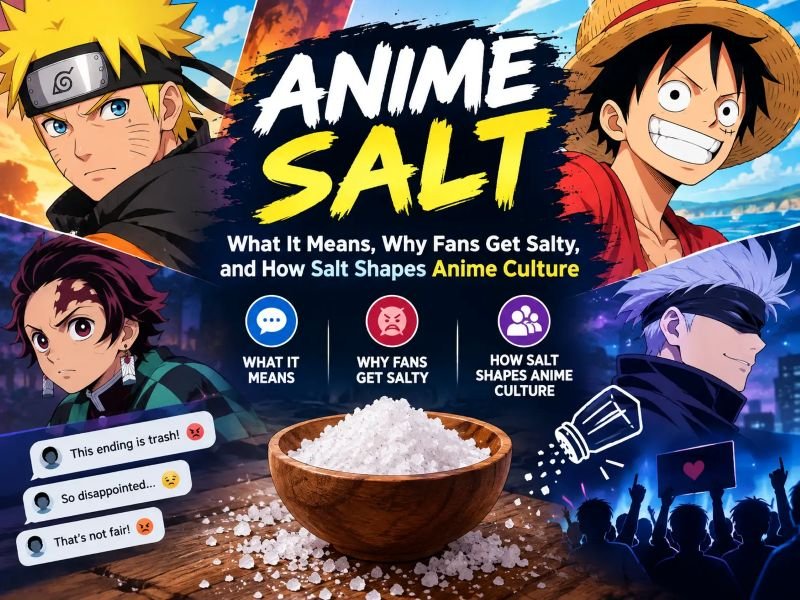
Introduction: Why Everyone Keeps Talking About Anime Salt
If you spend any time in anime communities, you have seen it. A beloved character dies in an episode and the comment section fills with bitter replies. A studio announces a sequel that adapts the wrong arc and the timeline turns sour. A favorite ship loses the final-episode lottery and suddenly half the fandom is sprinkling salt emojis on every post. That is anime salt in its most familiar form, and it is as much a part of fan culture as theme-song remixes and opening-skip buttons.
But “anime salt” is also a slightly slippery phrase. Search for it and you will find three overlapping stories. The first is about salty anime fans, the people who get bitter, defensive or sarcastic when something disappoints them. The second is about salt bae anime moments, those exaggerated seasoning poses that animators love to parody. The third is about the real thing: salt as a food, a word and a ritual object in Japan, and how anime borrows from all three.
This article walks through each of them in plain language. You will learn what the term means, where the slang comes from, why anime fandom in particular produces so much of it, the different flavors of salt you will meet online, how the salt bae pose spread through Japanese animation, what the Japanese word for salty actually means, how salt shows up in anime food scenes and supernatural stories, and, most usefully, how to deal with your own salt without ruining your enjoyment of the hobby.
What Does Anime Salt Mean? A Clear Definition
The anime salt meaning comes from the English slang adjective “salty.” Being salty means being bitter, irritated or resentful, usually because of a loss, a perceived slight or a disappointing outcome, and usually in a way that other people can see. Emojipedia notes that the salt shaker emoji is used for exactly that idea, representing being salty in the sense of feeling bitter, upset or annoyed, and also the phrase “take it with a pinch of salt,” which means to treat something with skepticism.
In anime communities, “salt” is the general name for the mood and “salty” is the label for someone displaying it. So when you read that a fandom is “full of salt” after a season finale, it means a lot of people are frustrated and saying so. When someone writes “I’m not salty, I just think the ending was rushed,” they are playfully, or defensively, denying the label while still criticizing the show.
The core ingredients of anime salt
Most examples of anime salt share a few ingredients:
- An expectation: The fan wanted something specific, such as a certain pairing, a power-up, a plot twist, a faithful adaptation or a particular animation quality.
- A letdown: The show, studio, author or community did something different.
- A visible reaction: The fan posts, comments, quote-tweets, edits a meme or writes a long review to show how they feel.
- A bit of emotional heat: The reaction is more than simple disagreement. It carries irritation, sarcasm or resentment.
Notice what is missing: salt does not require the fan to be wrong. A fan can have a perfectly reasonable criticism and still deliver it in a salty way. Equally, a fan can be calm and polite while holding a harsh opinion, and nobody would call that salt. The word is about tone and feeling, not about whether the complaint is valid.
Is anime salt an insult?
It depends on who is saying it and why. Between friends, “you’re so salty right now” is usually a joke, a gentle tease. Self-applied, “I’m so salty about episode 12” is a humorous admission. Aimed at a stranger during an argument, though, “stay salty” can be a deliberate taunt, a way of saying “your anger amuses me.” The same word can be affectionate, neutral or hostile depending on context, which is part of why it has lasted so long.
Anime salt versus ordinary criticism
It helps to separate the two. Ordinary criticism says: “The pacing in the second half dragged, and the finale left several plot threads unresolved.” Salt says: “This is the worst ending in anime history and anyone who liked it has no taste.” The first can be debated. The second is mostly emotion looking for an audience. Good communities make room for the first and gently push back on the second.
Where the Word “Salty” Comes From
Before it was fan slang, “salty” was simply an adjective for food with a lot of salt in it. The leap from taste to temperament is an old one. Sailors have long been described as salty, meaning weathered, rough and sharp-tongued after years at sea. Over time the English language also attached the idea of sharpness and sting to salt, as in “rubbing salt in a wound” and “salt in the wound.” Both phrases picture salt as something that makes an injury hurt more.
The modern slang meaning, bitter or upset, spread widely through online gaming communities, where competitive players who lost a match were quick to accuse each other of being salty. From there the word traveled into streaming, social media and general internet culture, and then into anime fandom slang, where it fit effortlessly because anime fans have so many things to be passionate, and occasionally bitter, about.
The Japanese language works in a surprisingly parallel way, which we will explore later. The adjective shiokarai, literally “salty,” is mostly used for food, but language-learning resources point out it can also describe situations or emotions that feel sharp or intense. So the connection between salt and sharp feelings is not just an English quirk. It is a fairly natural human metaphor, which helps explain why the term feels intuitive even to people who first meet it in a subtitle or a Discord server.
A short glossary of related fandom words
If you are new to this vocabulary, these terms often appear alongside anime salt:
- Salty: bitter, annoyed or resentful, usually about a loss or disappointment.
- Salt mine: a place, thread or community where lots of salty posts gather.
- Salt farming or salt harvesting: deliberately provoking salty reactions, or enjoying them for entertainment.
- Stay salty: a taunt telling someone to keep being upset.
- Copium: self-soothing excuses to avoid admitting disappointment.
- Hopium: over-optimistic expectations before an announcement.
- Cope and seethe: a mocking phrase paired with the idea of someone being upset and resentful.
- Hot take: a deliberately bold or unpopular opinion that often invites salty replies.
- Ratio: when replies to a post get more engagement than the post itself, signalling disagreement.
- Shipping: supporting a romantic pairing between characters.
- Ship war: an intense, often bitter argument between fans of rival pairings.
- Best girl or best boy: a fan’s favorite character, a very common trigger for salt.
You do not need to memorize any of this, but recognizing these words makes the comment sections far less confusing.
Why Anime Fandom Produces So Much Salt
Every fandom has salty moments, but anime has some structural reasons for generating a lot of them. Understanding these makes the whole phenomenon more forgivable, and also more manageable.
1. Deep emotional attachment to characters
Anime invites long relationships with its characters. A series might run for hundreds of episodes, or follow a protagonist from childhood to adulthood across several seasons. Viewers invest years. When a character is killed off, sidelined, rewritten or paired with someone unexpected, the reaction can feel personal. Salt is often grief, disappointment or loyalty wearing a sarcastic costume.
2. The adaptation gap
Many anime are adapted from manga, light novels or games. Readers of the source material have their own mental version of every scene, and they notice every cut, change or rushed arc. Meanwhile anime-only viewers experience the story fresh. This gap creates friction: source readers feel the adaptation is not faithful, and anime-only fans feel lectured. Both sides can get salty at each other.
3. Weekly release schedules and long waits
Seasonal anime airs on a weekly cycle, which gives fans a week to theorize, hope and build expectations between episodes. A week of speculation can create enormous pressure on a single episode to deliver. Long waits between seasons add to this. When an anticipated payoff arrives and is smaller than imagined, the swing from hype to disappointment is sharp.
4. Animation quality and production constraints
Fans are very aware of how animation is produced. They compare studios, notice staff changes and spot when a key scene looks weaker than expected. Debates about production schedules, budgets and working conditions are common. Sometimes the salt is about the art itself, sometimes about the idea that creators are being squeezed, and sometimes about a studio choice such as switching to computer-generated models for a hand-drawn series.
5. Competitive fan communities
Anime is full of rankings, power scaling, tier lists and “who would win” debates. Those debates are fun, but they also create winners and losers. If your favorite character is placed in the bottom tier or loses a hypothetical fight, you may feel a sting. Rankings such as seasonal polls and awards add another layer, because a clear winner implies clear losers.
6. Global community, local differences
Anime audiences span the world. Subtitle choices, localization decisions, dub casting, regional release dates and streaming availability all differ. Fans can feel frustrated by delays, censorship, translation choices or missing licenses. These are real, practical grievances that often feed salty posts, even when the show itself is excellent.
7. Social media rewards strong reactions
This is the part everyone shares. Platforms tend to amplify emotional posts because they attract replies, quote posts and screenshots. A calm, thoughtful review gets a polite like. A furious, funny rant gets shared. The result is that salt becomes more visible than it really is, so fandoms look angrier than their members typically feel offline.
8. The line between passion and gatekeeping
Some salt comes from gatekeeping: the belief that only “true fans” understand a series, or that newcomers are ruining it. Longtime fans can get salty when a franchise changes direction to attract a bigger audience, while newer fans can get salty when told their way of enjoying a show is wrong. Healthy communities try to keep enthusiasm and welcome in balance.
All of this explains why salty anime fans are not a special type of bad person. They are simply people who care a lot, in a medium designed to make you care a lot, communicating on platforms that reward strong emotion.
The Most Common Types of Being Salty in Anime
Not all salt tastes the same. Here are the most common varieties of being salty in anime, along with why they happen and what they usually sound like.
Ship war salt
Romantic pairings are among the most reliable sources of fandom heat. Anime ship wars happen when fans of different pairings argue over whose couple is more deserving, more consistent with the story or more likely to end up together. Salt flares when the series confirms one pairing, leaves things ambiguous or ends without resolving the question at all. The loser’s fans often claim the writing was unfair, while the winner’s fans may gloat. Both reactions feed the cycle.
The healthiest ship fans remember that characters are fictional and that the author is not obligated to match anyone’s preference. They also remember that enjoying fan works, headcanons and alternate pairings is part of the fun, regardless of what is canon.
Ending salt
Few things generate more salt than a controversial ending. A finale that feels rushed, ambiguous, overly bleak or disconnected from earlier themes can split a fandom for years. A well-known example is the polarizing reaction to the conclusion of the Attack on Titan manga in 2021, which prompted passionate defenses and strong criticism alike. The reason endings matter so much is simple: they are the last impression, and they shape how fans remember the entire journey.
Adaptation salt
Source readers who see arcs skipped, characters cut or tone changed in the anime adaptation often express frustration. Some compare older and newer adaptations of the same story, such as the debates over different Fullmetal Alchemist anime versions. The core complaint is usually that the adaptation did not respect what the fan loved most about the original.
Season-length and filler salt
Fans may feel salty when a story pauses for filler episodes, when an anime ends before the story is complete, or when a season is cut short. Filler is not always bad, but it can feel like wasted time when viewers are eager for the main plot.
Power-scaling and “who would win” salt
Debates over which character is the strongest can get surprisingly heated. When a character is shown losing, or when a fan feels the “rules” of the story’s power system were broken for plot convenience, salt tends to flow. This type of salt is often playful, but it can turn bitter quickly when fans treat a hypothetical as a verdict on their taste.
Sub versus dub salt
The subtitle-versus-dub argument is almost as old as anime fandom. Fans on both sides can get defensive about voice casting, translation choices and the idea that one way of watching is superior. The reality is that both options serve different audiences, and many fans happily use both, but this topic remains a dependable salt generator.
Rating and award salt
When a favorite show scores lower than expected on a ranking site or loses at an awards event, fans may call the results unfair. Because scores and awards feel like public verdicts, they invite emotional responses. Remember that ratings reflect the people who voted, not an objective truth about quality.
Streaming and availability salt
Sometimes the salt has nothing to do with the story. A show may not be available in a viewer’s region, may be removed from a platform, may be released late or may be censored in some versions. These frustrations are legitimate, and they are one reason fans pursue legal ways to watch and support the creators they love.
Gatekeeping and hot-take salt
Posting an unpopular opinion about a classic series is a quick way to trigger salty replies. Likewise, telling a fan that their favorite show is “for kids” or “not real anime” can produce an instant counterattack. Respectful disagreement is possible, but the tone online often escalates.
Self-directed salt
There is also the more humorous kind: fans being salty at themselves. Staying up too late for a weekly episode, regretting a spoiler or realizing a long theory was wrong can all inspire playful self-roasting. This kind of salt is usually harmless and often bonds communities together.
Anime Salt Bae: The Seasoning Pose Anime Loves to Parody
The second meaning of anime salt is much lighter. It refers to the “salt bae” gesture, a dramatic, elbow-high sprinkling motion that became an internet meme and then turned up in anime as a recurring visual gag.
What the pose looks like
The meme comes from a viral video of a chef seasoning meat with a theatrical flourish, sprinkling salt from a raised hand down onto the food. The meme went global, and creators everywhere began copying the stance. Anime is particularly good at this kind of parody because it already has a strong tradition of exaggerated poses, close-ups and comedic timing.
The Japanese-language resource Japanese With Anime documents how characters in many series strike a specific pose when sprinkling salt, spices or similar seasonings, and explains that the meme is known in Japanese as shio-furi ojisan, which translates roughly as the “salt-sprinkling old man.” The same page notes that the meme has also been rendered as shio no koibito, or “salt lover,” in Japanese references.
Examples of the salt bae anime moment
According to that collection, the parody has appeared in a range of series. Examples listed include episodes of That Time I Got Reincarnated as a Slime, Black Clover, Mob Psycho 100 II, Pop Team Epic, Jashin-chan Dropkick, Meikyuu Black Company, Idol Time PriPara, and others, including a parody involving Senku from Dr. Stone. The list shows how widely the gag spread across genres, from fantasy to idol shows to workplace comedies.
If you want to verify specific episodes yourself, the source page is linked in the sources section at the end of this article, and it is worth browsing for the screenshots.
Why the pose works so well in anime
There are a few reasons the salt bae pose fits anime so naturally:
- Anime loves dramatic body language: Exaggerated stances are part of the visual vocabulary.
- Food scenes are everywhere: Cooking and eating appear in almost every genre, so the gag has a natural home.
- Parody is a staple of the medium: Anime often references memes, other shows and pop culture for comedic effect.
- It is easy to recognize: Even viewers who have never seen the original meme understand that the character is being theatrical about seasoning.
How salt bae and salty fans overlap
The two meanings of anime salt are connected more than you might think. Online, fans sometimes use the salt bae image as a reaction meme when others are being salty, as if sprinkling extra salt on a heated argument. It is a joke about stirring the pot. If you see that image in a comment section, it usually means someone is teasing the situation rather than arguing seriously.
Salt in Japanese Language and Culture: From Shiokarai to Sumo Rings
The third meaning of anime salt takes us out of fandom and into Japan itself. Anime is made by Japanese studios, often for Japanese audiences first, so the way salt appears on screen is shaped by real language and real customs. Knowing the background makes many scenes richer.
The word for salt: shio
The Japanese word for salt is shio, written with the kanji. It appears in everyday vocabulary, in place names, in personal names and in food terms. Language-learning resources such as Nihongo Classroom list simply as meaning “salt” and treat it as a standard kanji that learners meet at an intermediate level.
Shiokarai: the adjective for salty
The adjective for “salty” is shiokarai. It combines the kanji for salt with the kanji for hot, spicy or harsh. Nihongo Classroom explains that it is mostly used for food and can suggest something overly salty, with a sharp or briny taste, and adds that it can also be used metaphorically for situations or emotions that feel sharp or intense. Example sentences from that resource include a soup that is too salty and pickles that are too salty.
This is a fascinating overlap with the English slang. In English, “salty” for a person is an informal, modern, internet-driven idea. In Japanese, the base word has a similar sense of sharpness, but it is not the main way people describe a bitter fan. Japanese fans use their own vocabulary for complaints and disappointment. So when an English-language fan says a character is “salty,” it is borrowing an English idiom, not translating a Japanese one. That distinction is worth remembering when you see subtitles or fan translations that choose “salty” for a line of dialogue: it is a localization choice, not necessarily a literal rendering.
Salt in everyday Japanese food
Salt sits at the center of Japanese cooking. Think of shioyaki, fish grilled simply with salt. Think of shio ramen, a broth seasoned primarily with salt. Think of onigiri, rice balls traditionally shaped with salted hands, or umeboshi, pickled plums known for their intense salty-sour taste. Also remember shiokara, a traditional dish of salted, fermented seafood, whose name uses the same characters as the adjective shiokarai but refers to the food itself. Salt is not just flavor in these dishes. It is preservation, texture and tradition.
Because anime features so many meals, from convenience-store snacks to elaborate banquet scenes, salt is frequently present even when nobody mentions it.
Morijio: piles of purifying salt
In Japan you may spot small cones of salt placed beside the entrance of a shop or restaurant. This custom is called morijio. It is commonly explained as a way to purify a place and welcome good fortune, though different people give different reasons and practices vary by region and business. Anime and live-action dramas set in traditional neighborhoods sometimes show these little salt piles in the background, a quiet detail that signals the setting.
Sumo and salt-throwing
One of the most visible uses of salt in Japanese culture is sumo. Before bouts, wrestlers scatter handfuls of salt into the ring. This is widely understood as a purification ritual that links sumo to its Shinto-influenced roots. If you have ever seen a sumo scene in an anime, the dramatic toss of salt, followed by a slow stomp and a stare-down, is meant to feel solemn and powerful. Comedy anime often exaggerate it, which brings us right back to the theatrical salt-sprinkling spirit of the salt bae meme.
Purifying salt after funerals
In many Japanese funeral customs, attendees receive a small packet of purifying salt, called kiyome-jio, to sprinkle on themselves before entering their homes. Practices differ by religion and region, and not every tradition uses it. In fiction, the custom can appear as a short moment of mourning, a reminder that salt is tied to the boundary between ordinary life and death.
What this means for anime viewers
Once you know these practices, certain scenes read differently. A character carefully pressing salt onto rice might be showing care, not just seasoning. A shopkeeper tidying a pile of salt at the door is quietly protecting their business. A wrestler tossing salt is starting a ritual, not a gag. Even when a series plays these customs for laughs, the humor depends on the audience recognizing the real tradition.
How Salt Appears in Anime Food Scenes and Storytelling
Now that we have the cultural background, let us look at how anime food scenes and stories use salt, from literal seasoning to symbolic purification.
Food scenes and the theater of seasoning
Cooking anime treat the kitchen as a stage. Series centered on cooking, such as Food Wars! (Shokugeki no Soma) or dungeon-cuisine comedies like Delicious in Dungeon, put seasoning, timing and technique in the spotlight. A single pinch of salt can decide a duel, reveal a character’s skill or expose their mistake. The lesson these shows teach, almost accidentally, is the one real chefs repeat: salt is about balance, and a little too much or too little changes everything.
Even outside cooking series, a character cooking for someone else is a classic way to show affection, awkwardness or growth. Burnt rice, oversalted soup and perfectly seasoned stew all say something about the person who made them. When a character is told their cooking is “too salty,” it often doubles as a gentle commentary on their feelings or effort.
Salt as protection from spirits and bad luck
Supernatural stories inspired by Japanese folklore often use salt as a protective or cleansing element. The idea is that salt purifies spaces, wards off malevolent presences or clears away misfortune. This trope is not unique to Japan, since many cultures link salt with protection, but it fits naturally with the Shinto-influenced customs described earlier. When a character scatters salt at a doorway, around a ritual space or over their own shoulders in an anime, they are using visual shorthand for “cleanse this place.”
Salt as a symbol of tears and emotion
Because tears are salty, writers sometimes use salt as a symbol of sorrow or release. A salty taste during an emotional scene, a character tasting their own tears, or a seaside setting heavy with salt air can all reinforce a mood. This quiet symbolism may not be labelled, but attentive viewers pick up on it.
Salty characters: the sharp-tongued archetype
Anime has no shortage of characters whose personalities could fairly be described as salty in the slang sense: sharp-tongued, sarcastic, quick to take offense. The tsundere is the best-known example, hiding affection behind prickly behavior, but there are many others, including cynical mentors, sarcastic rivals and grumpy veterans. Fans often adore these characters precisely because the salt hides a softer center, which is a nice reversal of the way the same word is used for annoyed fans.
Salt in titles, names and puns
Because shio is such a common word, it shows up in character names, jokes and wordplay. Writers enjoy puns that play on salt as seasoning and salt as attitude. If you read a fan translation that makes a salt pun, it is often a case of the translator choosing an English idiom to preserve the humor.
Anime Memes, Emoji and the Language of Salt Online
If you want to participate in conversations about anime salt without confusion, it helps to know the visual and verbal shorthand.
The salt shaker emoji
The salt shaker emoji (🧂) was approved as part of Unicode 11.0 in 2018, according to Emojipedia. It is used for anything related to salt and seasoning, and also for the idea of being salty or taking something with a pinch of salt. In anime spaces, the emoji is often dropped under a post as a quick way to say “that fandom reaction is a bit bitter,” or placed beside your own post as a humorous admission that you are upset.
Reaction images and GIFs
Common anime memes about salt include characters dramatically sprinkling seasoning, characters scowling with a salt shaker edit, and screenshots of characters reacting with exaggerated disdain. The salt bae pose, discussed earlier, is a staple. These images usually signal teasing rather than genuine hostility.
Typical phrases
You will often see phrases such as:
- “The salt is real.”
- “This thread is a salt mine.”
- “I’m not salty, I’m just disappointed.”
- “Pass the salt.”
- “Salt levels are critical.”
- “Take it with a grain of salt.”
The last phrase is worth noting because it means something different. “Take it with a grain (or pinch) of salt” is an old expression about skepticism, not about being bitter. Anime communities use it when sharing rumors, leaks or unconfirmed announcements.
Reading tone correctly
Salt jokes are easy to misread. Text strips away voice and facial expression, so a playful tease can look like an attack and a serious complaint can look like a joke. When in doubt, look at the surrounding context: emojis, punctuation, the history between the speakers and the community’s usual tone all provide clues. If you genuinely cannot tell, assuming good faith is the safer and kinder default.
How to Deal With Your Own Anime Salt
Everyone gets salty sometimes. The goal is not to remove the feeling but to handle it in a way that does not spoil your hobby or hurt other people. Here are practical steps that apply to almost any situation.
1. Name the feeling
Before posting, pause and ask what you are really feeling. Is it disappointment? Grief over a character? Frustration with a studio? Embarrassment about a prediction that was wrong? Naming the emotion makes it easier to decide what to do next. Many salty posts are simply unprocessed feelings.
2. Wait before you post
A good rule of thumb is to wait at least until the end of your next meal, or even overnight, before posting a long rant. A cooled-down take is almost always clearer, fairer and more persuasive. If you still feel strongly after waiting, you can post with confidence that it reflects what you actually think.
3. Separate the work from the people
Criticizing a plot decision is not the same as attacking the writer, voice actors or other fans. Keep your critique focused on specifics: pacing, structure, themes, animation or direction. Personal insults rarely persuade anyone and can cause real harm. This is especially important when creators and cast members are real people who may read what you write.
4. Be specific
“This ending is trash” gives other readers nothing to discuss. “The final episode resolved the main conflict but left the supporting characters’ arcs unfinished” gives them something concrete. Specific criticism is more respectful, more useful and, ironically, more likely to be heard.
5. Acknowledge what you did enjoy
Even when you are disappointed, you probably liked something about the show: a character, a soundtrack, a fight scene, a theme. Mentioning it makes your criticism more balanced and reminds you why you cared in the first place.
6. Take a break from the feed
If a fandom space is making you angrier every time you open it, muting words, leaving a thread or logging off for a day is perfectly reasonable. Fandom is supposed to add joy to your life. You are allowed to step away from the salt mine.
7. Remember that taste is subjective
Two people can watch the same episode and come away with opposite impressions. Neither is necessarily wrong. Treating your opinion as one perspective, not the final verdict, lowers the temperature of nearly every discussion.
8. Redirect the energy
Sometimes the best response to disappointment is to make something: write a review, draw fan art, record an essay, rewatch an old favorite, discover a new series or join a more constructive discussion group. Channeling frustration into creativity feels better than doom-scrolling.
9. Support creators in positive ways
If you are salty about a studio’s decisions, consider supporting works you do like through legal channels. Positive support, such as buying merchandise, watching on official platforms and recommending good shows, communicates more clearly than complaints.
How to Disagree Without Making It Salty: A Guide for Fans, Moderators and Creators
Healthy communities do not eliminate disagreement. They make it safe and productive. Here is how different people can help.
For everyday fans
- Assume good faith: Most people who disagree with you are not trying to ruin your day.
- Ask questions: “What did you like about that arc?” opens a conversation; “How could you possibly like that?” shuts it down.
- Avoid piling on: If someone is already getting salty replies, adding your own rarely helps.
- Use spoiler warnings: Spoiling an ending can trigger salt that was entirely avoidable.
- Respect different ways of watching: Subs, dubs, binge-watching, weekly viewing and re-reading the manga are all legitimate.
For community moderators
- Write clear rules: Spell out what counts as harassment, spoilers, brigading and off-topic arguments.
- Use dedicated threads: Ending discussions, ship debates and rating arguments can have their own spaces so they do not flood every conversation.
- Moderate behavior, not opinions: A strongly worded criticism is allowed; insulting other members is not.
- Offer cool-down tools: Slow mode, temporary mutes and clear escalation steps help conversations recover.
- Model the tone you want: Moderators who respond calmly set the standard for everyone else.
For writers and creators of fan content
- Give context: A review or essay that explains its reasoning is more credible than one that only vents.
- Disclose bias: If you love or hate a franchise, say so.
- Avoid bait: Deliberately inflammatory titles may bring clicks, but they also contribute to a sourer community.
- Correct your mistakes: If you got a fact wrong, update the post. It builds trust.
These habits benefit everyone, including the creators of the anime itself, who generally want their audiences to feel excited and welcome.
Is Anime Salt Always a Bad Thing?
It is tempting to treat salt as purely negative, but that is too simple. Salt, in the culinary sense, is essential to flavor, and in the fandom sense, it can serve several useful purposes.
- It shows that people care: Nobody gets salty about a show they do not love. Strong reactions are often a sign of deep engagement.
- It can highlight real problems: Complaints about poor working conditions, censorship, delayed releases or unfair treatment of characters sometimes begin as salty posts and grow into constructive discussions.
- It builds community humor: Playfully calling each other salty, sharing salt memes and laughing about collective disappointment can bring fans together.
- It sparks creativity: A disappointing ending has inspired countless fan fixes, alternate endings and thoughtful essays.
The key is moderation. Too little salt and everything tastes bland, with no passion or debate. Too much salt and the whole dish is ruined. The best fandoms find a balance where people can express strong opinions without losing respect for each other.
Frequently Asked Questions About Anime Salt
What does anime salt mean?
Anime salt is fan slang for bitterness or irritation related to anime, such as frustration about an ending, a ship outcome, an adaptation choice or a rating result. A person showing this feeling is called “salty.” The phrase can also refer to the salt bae pose in anime and to the cultural role of salt in Japan, depending on context.
What does being salty in anime communities mean?
Being salty in anime circles means showing visible resentment or disappointment, usually after something did not go your way. It can range from a lighthearted joke to a genuinely hostile attitude, so tone and context matter.
Is “salty” the same word as the Japanese shiokarai?
Not exactly. Shiokarai is the Japanese adjective for salty, mainly describing food, though it can occasionally be used metaphorically for sharp or intense situations or emotions, according to Nihongo Classroom. The English slang “salty” meaning bitter is a separate, modern internet usage, so they overlap in imagery but are not direct translations.
What is salt bae in anime?
Salt bae anime moments are scenes where a character sprinkles seasoning with an exaggerated, dramatic hand motion that parodies a viral internet meme. In Japanese the meme is referred to as shio-furi ojisan, meaning roughly “salt-sprinkling old man.” Examples have been catalogued across many series, including Black Clover, Mob Psycho 100 II and That Time I Got Reincarnated as a Slime.
Why do anime fans get so salty?
Because anime encourages deep attachment to characters and stories, features weekly releases that build expectations, involves adaptation changes that disappoint source readers, and thrives on social platforms that reward emotional posts. Competitive debates about ships, power levels and rankings add even more fuel.
What is a ship war?
A ship war is an intense argument between fans who support different romantic pairings in a story. Anime ship wars often flare around finales, because the ending can confirm one pairing and disappoint the others.
What does the salt emoji mean?
The salt shaker emoji (🧂) is used for salt and seasoning, and also to suggest being salty (bitter or upset) or to express the idea of taking something with a pinch of salt (treating it with skepticism), as Emojipedia describes.
Is salt important in Japanese culture?
Yes. Salt is used in countless dishes, in purification customs such as morijio at shop entrances, in sumo rituals where wrestlers scatter salt in the ring, and in some funeral traditions where attendees receive purifying salt. Practices vary by region and belief, but salt has a clear symbolic role alongside its practical one.
How can I stop being salty about an anime?
Name the feeling, wait before posting, focus on specific criticism rather than personal attacks, acknowledge what you enjoyed, step away from heated spaces, and channel the energy into something creative or positive. If a particular community makes you more upset than happy, take a break.
Can anime salt be funny?
Absolutely. Many fans use salt as a running joke, with memes, emojis and exaggerated reactions that poke fun at their own disappointment. The humor works best when it is self-aware and aimed at situations, not at individual people.
Are salty fans bad for anime?
Not inherently. Strong emotion shows engagement, and constructive criticism can improve communities and sometimes influence industry practices. The harm comes when salt turns into harassment, threats or relentless negativity toward creators and other fans. Healthy fandoms keep passion without crossing that line.
Conclusion: Seasoning Your Fandom Wisely
Anime salt is a small phrase that points to something big: the intense, funny, messy and deeply human way people respond to stories they love. It is the bitter comment under a controversial finale, the sprinkle of a salt bae parody in a comedy episode, the humble salt on a rice ball in a quiet kitchen scene, the pile of purifying salt at a shop door and the handful of salt thrown into a sumo ring. Different meanings, one shared ingredient.
If you remember only a few things from this guide, let them be these. First, the anime salt meaning in fan spaces is about feeling and tone, not about whether a criticism is correct. Second, salty anime fans are usually just passionate people reacting to disappointment, and understanding why it happens makes it easier to respond with patience. Third, salt bae anime moments and Japanese salt customs are a reminder that salt has a rich, playful and meaningful history that extends far beyond slang. And finally, you can enjoy the hobby more by managing your own salt: pause before posting, be specific, respect other fans and keep room for the things you still love.
