

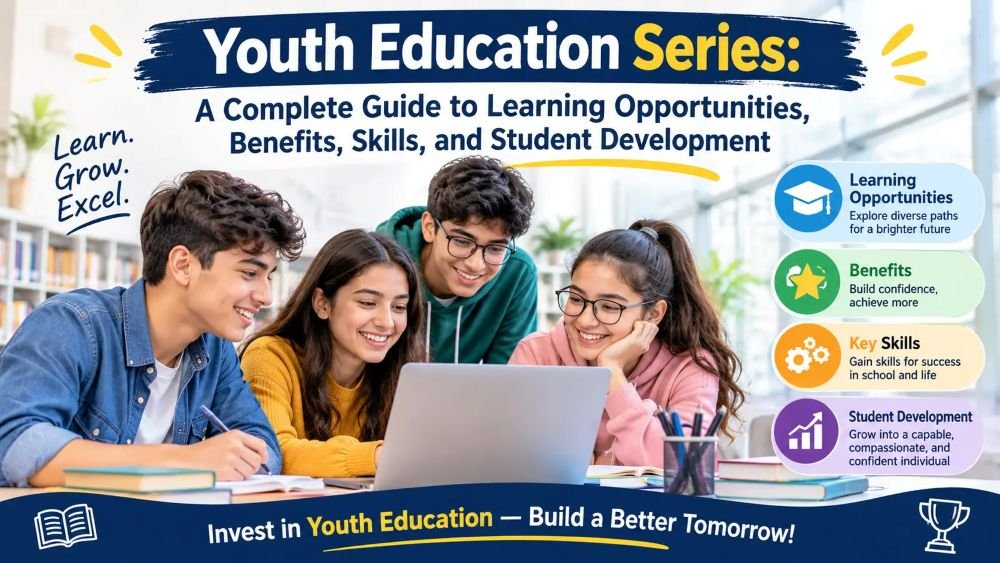
Education plays an important role in shaping the future of young people. It helps children and teenagers understand the world, develop useful skills, discover their interests, and prepare for future opportunities. However, learning does not have to happen only through textbooks, homework, and classroom examinations. Young people can also learn through practical activities, educational workshops, creative projects, teamwork, and real-world experiences.
A youth education series is one approach to organizing these learning opportunities into a connected program. It can include lessons, workshops, educational videos, interactive activities, mentoring sessions, and projects that help students build knowledge over time. The exact format depends on the organization, the age group, and the learning objectives.
Parents, teachers, schools, community organizations, and educational providers can use youth learning programs to support students beyond their regular classroom experiences. These programs may focus on science, technology, communication, leadership, financial awareness, environmental responsibility, creative arts, or career exploration.
In this guide, we explain what a youth education series means, how these programs work, their potential benefits, the skills students can develop, and how parents and educators can choose suitable opportunities. We also discuss practical activities, online learning, safety considerations, and ways to measure educational progress.
What Is a Youth Education Series?
A youth education series is a structured collection of educational sessions or learning resources designed for children, teenagers, or young adults. Instead of presenting a single lesson or isolated activity, a series usually connects several learning experiences around a common topic or objective.
For example, a school might organize a six-session series about environmental awareness. Students could learn about waste management in the first session, explore recycling in the second, study water conservation in the third, and complete a community project during the remaining sessions.
Each activity contributes to a larger learning goal. Students have opportunities to understand concepts, practice new skills, ask questions, and reflect on their progress.
The term does not refer to one universal program. Different organizations use similar terminology for different educational initiatives. Some series focus on classroom learning, while others emphasize hands-on experiences, cultural activities, leadership, career preparation, or digital education.
The Disney Youth Education Series, for example, is a specific branded educational program. Hong Kong Disneyland describes hands-on experiences that connect classroom learning with topics such as science, animation, storytelling, environmental awareness, and career planning. Readers interested in that particular program should consult the official Disney website for current details.
In a broader educational context, a youth education series can be created by a school, nonprofit organization, museum, library, community center, educational company, or online learning provider.
How Is a Youth Education Series Different From a Regular Class?
A regular class generally follows a curriculum that covers a subject over a term or academic year. A youth education series can complement that learning by concentrating on a particular theme, skill, or practical objective.
For instance, students studying science in school might attend a separate series about robotics. They could learn basic engineering concepts, work in small groups, build simple models, and present their completed projects.
The additional experience gives students an opportunity to apply what they have learned.
However, a youth education series does not automatically provide a better educational experience than a traditional class. Its value depends on the quality of instruction, the relevance of the material, the suitability of the activities, and the support provided to learners.
Who Can Participate in Youth Education Programs?
The intended participants depend on the program.
Some educational series are designed for primary school children, while others target middle school students, teenagers, or young adults. Certain programs welcome mixed-age groups, whereas others separate participants by age, educational level, or prior experience.
Common participant groups include:
- Primary school students learning foundational academic and social skills.
- Middle school students exploring science, technology, creativity, and teamwork.
- Teenagers preparing for examinations, future careers, and greater independence.
- Young adults developing professional, communication, and practical life skills.
- Students who want to explore interests outside their regular curriculum.
- Youth groups seeking structured activities and community learning opportunities.
Before enrolling, participants and their parents should review the program’s age requirements, prerequisites, schedule, costs, accessibility arrangements, and learning objectives.
Why Is a Youth Education Series Important?
Young people need opportunities to develop academic knowledge, practical abilities, and confidence. Traditional education remains essential, but students may also benefit from activities that help them apply their knowledge to real situations.
A thoughtfully planned youth education series can connect these different aspects of learning.
1. It Connects Knowledge With Practical Experience
Students often understand a concept more clearly when they have an opportunity to use it. Reading about plants, for example, provides useful information, but growing a small garden can help learners observe how plants respond to sunlight, water, and soil conditions.
Practical activities also encourage students to ask questions. They might compare the growth of two plants, record observations, and discuss why the results differ.
The same approach can apply to mathematics, technology, writing, art, and other subjects.
An effective educational series gives students opportunities to move from understanding an idea to applying it. Activities should remain appropriate for their age and should include guidance from a qualified educator or responsible adult when needed.
2. It Encourages Curiosity
Curiosity motivates students to explore unfamiliar subjects. When a program allows learners to investigate questions and experiment with ideas, it can make education feel more engaging.
A science series might ask students to investigate how shadows change throughout the day. A history series might invite them to compare historical photographs and written records. A technology series might encourage them to design a simple solution to an everyday problem.
These activities give students a reason to ask questions rather than simply memorize information.
Educators can support curiosity by welcoming thoughtful questions, encouraging discussion, and treating mistakes as opportunities to learn.
3. It Supports Personal Development
Educational programs can provide opportunities to practice patience, responsibility, decision-making, and self-reflection.
For example, a student working on a group project may need to organize tasks, manage time, communicate with classmates, and respond constructively when an idea does not work.
These experiences can help students recognize their strengths and identify areas where they need additional practice.
Personal development should not be measured only by whether a student wins a competition or completes a project first. Progress may also involve asking for help, listening to another person’s perspective, or trying again after a setback.
4. It Introduces New Interests
Students may not know whether they enjoy coding, public speaking, photography, environmental science, or creative writing until they have a chance to try these activities.
A youth education series can introduce several subjects in an organized and relatively low-pressure setting.
A student who attends a robotics workshop might discover an interest in engineering. Another student may enjoy storytelling and decide to explore writing, journalism, or filmmaking.
Not every activity will become a long-term interest, and that is perfectly normal. Exploration helps young people make more informed choices about how they want to spend their time.
5. It Encourages Collaboration
Many educational activities require students to work together. They may design a poster, conduct a small experiment, prepare a presentation, or plan a community initiative.
During these activities, students practice dividing responsibilities, discussing different ideas, and reaching decisions.
They also learn that collaboration does not mean everyone must agree. A useful group discussion allows participants to explain their reasoning, consider evidence, and find a practical way forward.
These experiences can support communication and teamwork in school and other settings.
6. It Helps Students Explore Future Opportunities
Young people sometimes find it difficult to connect school subjects with future education or employment.
Career-focused youth education programs can introduce different occupations, educational pathways, and workplace skills. Guest speakers, supervised demonstrations, career research, and practical projects can help students understand what different roles involve.
For example, a student interested in environmental protection might explore careers in conservation, environmental engineering, public policy, or scientific research.
Such activities should present realistic information rather than promise that participation will lead to a particular job or salary.
Main Types of Youth Education Series
Youth education programs can cover many subjects. The best format depends on the participants’ interests, learning needs, available resources, and the purpose of the series.
1. Academic Learning Programs
Academic programs help students strengthen their understanding of school subjects. They may focus on mathematics, science, reading, writing, languages, or examination preparation.
A mathematics series might include problem-solving challenges, practical measurement activities, and explanations of difficult concepts. A reading series could help students discuss characters, identify themes, expand vocabulary, and improve comprehension.
Academic support can be especially useful when a student needs additional practice with a particular subject.
However, supplementary programs should complement schoolwork rather than overload students with unnecessary assignments. A good program takes the learner’s existing workload and ability into account.
2. Science, Technology, Engineering, and Mathematics Programs
Science, technology, engineering, and mathematics, commonly grouped under STEM, offer many opportunities for practical learning.
Students might investigate simple scientific questions, design structures, learn introductory coding, explore measurement, or build age-appropriate models.
A beginner robotics series could introduce students to basic instructions, sensors, movement, and problem-solving. A science series could focus on water filtration, plant growth, electricity, or the properties of everyday materials.
These activities should use appropriate equipment and follow safety instructions. Younger students may require close supervision, particularly when tools, electrical components, heat, or chemicals are involved.
The goal is not to make every student pursue a technical career. STEM activities can also develop observation, reasoning, creativity, and persistence.
3. Arts and Creative Learning Programs
Creative education helps students explore ideas through drawing, painting, music, dance, theatre, photography, writing, and other forms of expression.
An arts-focused series might introduce students to basic design principles, storytelling techniques, rhythm, or stage performance. Participants could create individual pieces and then discuss how different choices communicate meaning.
Creative activities can give students a way to express ideas that they find difficult to communicate through conventional written assignments.
Educators should encourage experimentation rather than compare every learner against a single artistic standard. Students have different interests, abilities, and preferred methods of expression.
4. Leadership and Teamwork Programs
Leadership education can help students understand responsibility, cooperation, planning, and ethical decision-making.
A youth leadership series might ask participants to identify a problem in their school or community and propose a realistic solution. They could research the issue, discuss possible actions, assign responsibilities, and present their recommendations.
Leadership should not be presented only as managing other people. It can also involve listening carefully, supporting a team, admitting mistakes, and taking responsibility for agreed tasks.
Programs should give participants opportunities to practice these abilities instead of relying entirely on lectures about leadership.
5. Financial Literacy Programs
Financial literacy introduces students to everyday money concepts.
Depending on their age, participants might learn about saving, budgeting, needs and wants, spending decisions, banking basics, online scams, and the importance of evaluating financial information.
A simple classroom activity could give students a fictional monthly budget and ask them to allocate money to different expenses. They could then discuss how unexpected costs affect their plans.
Teenagers may benefit from learning about bank accounts, digital payments, responsible borrowing, and consumer protection.
Financial education should use clear examples and avoid presenting risky investments or unverified financial promises as reliable ways to make money.
6. Environmental Education Programs
Environmental education helps students understand natural systems and the effects of everyday decisions.
Topics can include biodiversity, waste reduction, recycling, energy use, water conservation, pollution, and sustainable living.
Students might conduct a classroom waste audit, grow plants, create an awareness poster, or measure how much paper their class uses during a week.
A community project could encourage responsible waste disposal or promote water-saving habits.
Environmental education works best when learners receive accurate information and can connect larger issues with actions appropriate to their circumstances.
7. Digital Literacy and Online Safety Programs
Digital literacy involves more than learning how to operate a computer or smartphone. Students also need to understand how to find information, evaluate online claims, protect their privacy, and communicate responsibly.
A digital literacy series might teach learners to recognize suspicious messages, use strong passwords, verify sources, understand digital footprints, and identify misleading images or headlines.
Older students can explore responsible use of artificial intelligence tools, including how to check generated information and acknowledge sources when required.
Online safety activities should explain why personal information matters and how students can seek help if they encounter harassment, scams, or inappropriate content.
8. Communication and Public Speaking Programs
Communication skills support learning, relationships, and future work.
A communication-focused series might teach students how to organize ideas, listen actively, ask useful questions, write clearly, and present information to an audience.
Participants could prepare a short speech, interview a classmate about a topic, or explain a project to a small group.
Students who feel nervous about speaking in public should receive gradual opportunities to participate. They should not be embarrassed or forced into unnecessarily stressful activities.
9. Health and Everyday Life Skills Education
Age-appropriate life skills education can cover personal organization, decision-making, healthy routines, basic safety, conflict resolution, and help-seeking.
For example, students might practice planning a weekly schedule, preparing a simple list of priorities, or identifying trusted adults they can approach when they need support.
Programs should use reliable educational resources and refer sensitive medical or mental health questions to appropriately qualified professionals.
The aim is to help young people make informed decisions while understanding when they need adult guidance.
10. Career Exploration Programs
Career exploration introduces students to different professions, industries, and educational routes.
Activities might include researching occupations, interviewing professionals, comparing course requirements, or preparing a basic portfolio of projects.
Students can also learn about transferable skills such as writing, problem-solving, teamwork, and digital communication.
Career programs should recognize that interests and plans can change. Their purpose is to broaden awareness and support informed choices, not pressure young people to select a permanent career too early.
Benefits of Youth Education Programs for Students
A youth education series can offer several potential benefits when it is well designed, accessible, and appropriate for the participants.
Better Understanding of Complex Topics
Interactive explanations and practical exercises can help learners connect abstract concepts with familiar examples.
A student studying fractions, for example, might use measurements in a cooking activity. A student learning about ecosystems might observe a local garden or analyze a simple food web.
These activities can provide additional ways to understand a topic, especially when students find textbook explanations difficult.
Greater Confidence Through Practice
Confidence often develops when learners have opportunities to practice a skill and observe their progress.
A student who struggles with presentations might begin by speaking for one minute to a small group. After receiving supportive feedback, the student could prepare a longer presentation.
Progress will vary, and confidence should not be treated as a guaranteed outcome. Educators can help by setting achievable goals and recognizing effort alongside successful results.
Stronger Problem-Solving Habits
Problem-solving activities encourage students to identify a challenge, gather information, consider possible solutions, and evaluate results.
For example, a group designing a paper bridge could test different shapes, record how much weight each design supports, and explain why some structures perform better than others.
The activity teaches students to use evidence rather than rely only on their first assumptions.
Improved Communication
Group discussions, presentations, and collaborative projects provide opportunities to practice explaining ideas clearly.
Students can learn to ask questions, summarize another person’s point, and disagree respectfully.
These skills require repeated practice. A single workshop may introduce useful techniques, but continued opportunities help students apply them in different situations.
Opportunities for Social Connection
Group learning can bring together students with shared interests. They may develop friendships, exchange ideas, or discover different perspectives.
Programs should create an inclusive atmosphere where participants are treated respectfully and can contribute without fear of bullying or discrimination.
Social connection is a potential benefit, not a guaranteed result. Organizers should establish clear expectations for behavior and provide a way to report concerns.
Awareness of Personal Strengths
Students sometimes discover abilities through activities that differ from their usual schoolwork.
A learner who finds written examinations difficult may excel at explaining a process visually. Another may demonstrate strong organization during a group project.
Recognizing these strengths can help students understand their learning preferences and identify areas for further development.
How to Design an Effective Youth Education Series
Schools, community organizations, educators, and other program providers can use a structured planning process to create meaningful educational experiences.
Step 1: Identify the Main Learning Goal
Begin by deciding what participants should understand or be able to do by the end of the series.
A broad goal such as helping students become successful is difficult to measure. A more useful goal might be helping participants prepare a presentation, complete a supervised science project, or develop a basic personal budget.
Clear goals guide the selection of activities and make evaluation easier.
Step 2: Understand the Target Age Group
Children, teenagers, and young adults have different levels of knowledge, independence, and experience.
A lesson that works for a 17-year-old may be too complicated for a 9-year-old. Younger participants may need shorter activities, simpler instructions, and more direct supervision.
Organizers should also consider language needs, accessibility, prior experience, and the different ways students learn.
Step 3: Break the Topic Into Sessions
Divide the main subject into manageable learning stages.
For example, a six-session environmental education series could follow this structure:
- Introduction to local environmental issues.
- Understanding waste and recycling.
- Exploring water conservation.
- Learning about plants and biodiversity.
- Planning a small environmental project.
- Presenting results and reflecting on lessons learned.
The sequence should move from basic understanding toward practical application.
Step 4: Select Appropriate Activities
Choose activities that directly support the learning goals.
Possible formats include demonstrations, group discussions, supervised experiments, creative assignments, educational visits, quizzes, and project-based learning.
Activities should give students meaningful opportunities to participate. A workshop becomes less useful when learners spend the entire session listening without asking questions or practicing skills.
Step 5: Prepare Reliable Learning Materials
Materials may include worksheets, books, presentations, videos, demonstrations, and recommended websites.
Organizers should check that the information is accurate, current where necessary, and suitable for the intended audience.
When using online material, educators should review the original source rather than rely only on an excerpt or social media post.
Copyright should also be respected. Use original materials, properly licensed resources, or content that can legally be shared.
Step 6: Assign Qualified and Responsible Facilitators
Facilitators should understand the subject they teach and know how to work with the relevant age group.
Depending on the activity, they may need specialist training, professional qualifications, safeguarding preparation, or technical expertise.
Organizers should establish clear responsibilities for supervision, communication with parents, incident reporting, and emergency arrangements.
Step 7: Include Feedback and Reflection
Students should have opportunities to explain what they learned, identify questions, and discuss challenges.
Feedback can come from instructors, peers, quizzes, project reviews, or short reflection activities.
Constructive feedback identifies specific areas for improvement. Instead of telling a student that a presentation was poor, an educator could explain that the main idea was clear but the supporting examples need more detail.
Step 8: Review and Improve the Series
After the program ends, organizers should review attendance, participation, learning outcomes, accessibility, and participant feedback.
They can use the findings to improve future sessions.
A series should not be judged only by how many people attended or whether participants said they enjoyed it. Enjoyment matters, but evidence of learning and the quality of the experience also deserve attention.
A Sample Six-Week Youth Education Series
The following example illustrates how an organization could structure a general student development program. It is a suggested model, not an existing or officially accredited course.
Week 1: Understanding Personal Learning Goals
Students identify their interests and select a skill they would like to develop. They discuss what makes a useful goal and create a simple plan for practicing it.
Suggested activity: Write one learning goal and identify three actions that could help achieve it.
Learning objective: Understand the connection between goals, practice, and progress.
Week 2: Communication and Teamwork
Participants practice listening, explaining ideas, and working with classmates.
Suggested activity: Small groups solve a problem that requires everyone to contribute information.
Learning objective: Recognize how communication and cooperation support group work.
Week 3: Digital Literacy
Students explore how to search for information, compare sources, and recognize common online risks.
Suggested activity: Compare two articles about the same topic and identify their authors, evidence, publication dates, and sources.
Learning objective: Develop basic habits for evaluating online information.
Week 4: Practical Problem-Solving
Students identify an everyday challenge and brainstorm possible solutions.
Suggested activity: Design a low-cost way to reduce unnecessary paper use in a classroom.
Learning objective: Practice generating ideas, comparing alternatives, and explaining decisions.
Week 5: Career and Life Skills
Participants research an occupation or skill that interests them. They identify the knowledge, training, and experience that may be required.
Suggested activity: Prepare a short career profile using reliable sources.
Learning objective: Understand how education and skill development connect with future opportunities.
Week 6: Final Project and Reflection
Students present a project or demonstrate a skill developed during the series.
Suggested activity: Deliver a short presentation describing the original goal, the work completed, the challenges encountered, and the next steps.
Learning objective: Communicate learning progress and identify opportunities for further development.
Organizers can adapt this model to different ages, subjects, budgets, and learning environments.
How Parents Can Choose the Right Youth Education Series
Parents often have several questions when comparing programs. They may want to know whether an activity is useful, affordable, safe, and suitable for their child’s interests.
The following checklist can help.
Check the Learning Objectives
Look for a clear explanation of what participants will learn.
A trustworthy provider should be able to describe the program’s subject, activities, intended age group, and expected learning outcomes.
Be cautious of broad promises that a short program will guarantee academic success, exceptional intelligence, or a particular career outcome.
Review the Provider’s Background
Find out who organizes the program and who will teach or supervise participants.
Depending on the setting, useful information may include instructor qualifications, relevant experience, safeguarding policies, references, and contact details.
For a program associated with a named institution or company, confirm details through that organization’s official website rather than relying exclusively on third-party articles.
Consider Your Child’s Interests
A program may be well organized but still be a poor fit for a particular student.
Ask your child which subjects they would like to explore. Some learners prefer practical projects, while others enjoy reading, discussion, art, or independent research.
A good match can help students participate more willingly and make better use of the opportunity.
Compare Costs and Requirements
Some educational activities are free, while others charge tuition, materials fees, admission costs, or transportation expenses.
Before registering, check the total cost, cancellation policy, required equipment, schedule, and any additional charges.
Also consider the time commitment. A valuable educational activity should fit reasonably well with schoolwork, rest, family responsibilities, and other interests.
Check Accessibility and Inclusion
Ask whether the provider can accommodate relevant accessibility needs and whether materials are available in an appropriate language or format.
Inclusive programs should aim to give students meaningful opportunities to participate, regardless of background or ability.
Parents can contact organizers before enrollment to discuss practical requirements.
Look for Meaningful Activities
Review the planned sessions to see whether students will actively engage with the material.
Practical work, guided discussion, projects, and useful feedback can make an educational series more engaging than a format that relies entirely on passive viewing.
However, the right balance depends on the subject. Some topics require direct instruction before students can practice safely or accurately.
Ask How Progress Is Evaluated
A provider may use projects, quizzes, demonstrations, attendance records, portfolios, or student reflections.
The assessment method should match the learning objectives.
Not every program needs a formal examination or certificate. The important question is whether the method gives participants and educators useful information about learning progress.
Online Youth Education Series: Opportunities and Challenges
Online education gives students access to learning materials beyond their immediate school or community.
A digital series might include recorded lessons, live classes, downloadable exercises, supervised projects, or discussion sessions. Students may be able to learn from educators who are not available locally.
Online learning can also reduce travel requirements and offer flexible schedules.
However, it presents challenges that parents and educators should consider.
Benefits of Online Learning
Online resources can help students revisit difficult lessons at their own pace. A learner who does not understand a mathematics explanation on the first attempt may watch it again and practice additional examples.
Digital programs may also provide interactive simulations, educational games, virtual demonstrations, and opportunities to collaborate remotely.
For students with limited access to specialized local classes, these options can broaden the range of available subjects.
Challenges of Online Learning
Not every household has a reliable internet connection, suitable devices, or a quiet place to study.
Some students also find it difficult to stay focused during long online sessions. Younger learners may require adult support to organize their schedules and complete activities.
Programs should account for these limitations instead of assuming every participant has the same technology and home environment.
Online Safety for Young Learners
Digital programs should protect participants’ privacy and provide clear rules for communication.
Parents should understand what personal information a platform collects, how accounts are managed, whether sessions are recorded, and who can contact students.
Young people should avoid sharing their home address, school details, passwords, private photographs, or other sensitive information with strangers online.
When a program includes live discussions or group chats, organizers should explain moderation arrangements and how participants can report inappropriate behavior.
Combining Online and Offline Activities
A blended approach can combine digital resources with practical learning.
For example, students might watch a short lesson about plant growth, grow a plant at home or school, record observations, and discuss their results during an online session.
This format can offer flexibility while still giving students an opportunity to apply what they learn.
The best format depends on the learning goal, participant needs, and resources available.
Youth Education Series and Real-World Learning
Real-world learning connects educational ideas with situations students can observe or experience.
It does not require expensive equipment or elaborate trips. Everyday environments can provide useful learning opportunities when activities have clear objectives.
Community-Based Learning
Students can explore issues in their neighborhoods, such as litter, public spaces, water use, or local history.
A supervised community project might involve documenting an environmental issue, researching relevant information, and preparing recommendations for a school or community group.
Organizers should obtain any necessary permissions and protect participants’ safety and privacy.
Educational Visits
Museums, science centers, libraries, cultural institutions, and other educational venues may offer activities that complement classroom learning.
Before arranging a visit, teachers should identify the learning goals and prepare students to make meaningful observations.
Afterward, participants could write a reflection, discuss what they discovered, or complete a related project.
An educational visit is more useful when students have a clear purpose than when they simply move through an attraction without engaging with its content.
Guest Speakers and Mentors
Professionals and experienced community members can help students understand how knowledge is used outside school.
A guest speaker might explain the steps involved in a scientific investigation, the daily responsibilities of a designer, or the communication skills needed in a community organization.
Students should have time to prepare questions and reflect on the answers.
Mentoring arrangements require appropriate supervision, boundaries, and safeguarding procedures, especially when adults work directly with minors.
Project-Based Learning
Project-based learning gives students an opportunity to investigate a question or create something over several sessions.
A group might design a basic educational website, prepare a local history display, or develop an awareness campaign about reducing waste.
Projects can encourage planning, research, teamwork, and communication.
Educators should ensure that tasks are manageable and that each participant has a meaningful role. Otherwise, one or two students may complete most of the work while others remain uninvolved.
How Youth Education Programs Support Career Readiness
Career readiness involves understanding workplace expectations and developing skills that can support future education and employment.
A youth education series can introduce some of these skills in an age-appropriate setting.
Research and Information Skills
Students can learn how to investigate an occupation, compare educational requirements, and distinguish reliable sources from unsupported claims.
For example, a learner interested in nursing could research recognized training pathways, typical responsibilities, and the importance of professional qualifications.
Information should be checked against trustworthy sources, especially when requirements vary by country or change over time.
Communication and Presentation
Many education and employment settings require people to explain ideas, write clearly, and work with others.
Students can practice these skills through reports, group presentations, interviews, and project demonstrations.
The purpose is to help learners express themselves accurately and respectfully, not to make every student adopt the same communication style.
Planning and Time Management
A longer project can teach students how to break a task into stages, estimate the time required, and track progress.
A simple plan might list research, drafting, review, and presentation as separate tasks.
When students miss a deadline, educators can help them identify what happened and revise the plan rather than treating every delay as a personal failure.
Understanding Workplace Ethics
Older students may benefit from introductory discussions about honesty, confidentiality, respectful behavior, responsible technology use, and accountability.
Case studies can help learners think through practical situations, such as how to acknowledge another person’s work or handle information they are not authorized to share.
These lessons should emphasize sound judgment and the importance of asking for guidance when a situation is unclear.
Common Challenges in Youth Education Programs
Even a well-intentioned series can face difficulties. Understanding these challenges helps organizers make better decisions.
Limited Funding
Some organizations cannot afford specialist equipment, transportation, venue rental, or paid instructors.
They may respond by using freely available educational materials, borrowing suitable equipment, collaborating with local institutions, or designing low-cost activities.
However, reducing costs should not compromise safety, accessibility, or the quality of instruction.
Unequal Access
Students may face barriers related to household income, disability, language, transportation, technology, or family responsibilities.
Organizers can assess these barriers before launching a program and consider flexible schedules, accessible materials, scholarships, and alternative participation methods.
No single solution will meet every need, but identifying barriers is an important first step.
Low Participation
Students may lose interest if activities feel repetitive, excessively difficult, or disconnected from their goals.
Educators can ask participants for feedback, explain why each activity matters, and provide a reasonable variety of tasks.
Participation may also be affected by transport, family schedules, fatigue, or other responsibilities. Organizers should investigate these factors rather than assume that every absence reflects a lack of interest.
Difficulty Measuring Results
Personal development and skill improvement can be difficult to measure with one score.
Organizers can combine different methods, such as observing project work, reviewing student portfolios, asking learners to reflect on progress, and comparing performance against clearly defined objectives.
Measurements should be interpreted carefully. An improvement in a short assessment does not necessarily prove that every aspect of a student’s learning has improved.
Maintaining Quality
A series may become less useful when lesson plans, supervision, and learning materials are inconsistent.
Organizers can develop session plans, train facilitators, collect feedback, and review the accuracy of educational content.
They should also provide a process for responding to complaints and addressing safety concerns.
How to Measure the Success of a Youth Education Series
Evaluation helps organizers understand whether a program is meeting its goals.
The appropriate methods depend on the subject, the age group, and the program’s duration.
Set Measurable Learning Objectives
Each objective should describe an observable outcome where possible.
For example, instead of saying that students will become better at research, an objective could state that students will identify an author’s name, publication date, and supporting evidence when evaluating an article.
Clear objectives make it easier to choose appropriate assessments.
Use Short Knowledge Checks
Quizzes, questions, and short exercises can help instructors identify topics that need further explanation.
These checks should match what students have been taught and should not create unnecessary pressure.
For younger learners, informal questions or demonstrations may be more appropriate than formal tests.
Review Practical Projects
Projects can show whether participants can apply concepts.
A science project might demonstrate understanding of variables and observations. A presentation might reveal how clearly a student can explain a process.
Rubrics can help educators assess work consistently by identifying specific criteria before the activity begins.
Ask Students for Feedback
Students can describe which activities helped them learn, where they felt confused, and what they would change.
Feedback forms should be appropriate for the age group and should allow students to raise concerns respectfully.
Organizers should explain how feedback will be used and avoid promising changes they cannot deliver.
Consider Longer-Term Progress
Some skills take time to develop. When practical and appropriate, educators may follow up to see whether students continue using what they learned.
For example, participants might report whether they have used a budgeting exercise or applied a research technique in a later assignment.
Long-term results should be interpreted carefully because many factors influence student development outside a single program.
Report Results Honestly
Program reports should distinguish between participation, satisfaction, demonstrated learning, and longer-term outcomes.
For example, attendance records can show how many students participated, while an assessment may provide evidence of a particular skill.
Neither measure alone proves that the program improved every aspect of a student’s development.
Honest reporting helps parents, educators, funders, and participants understand what the program achieved and where improvement is needed.
Youth Education Series: Safety, Inclusion, and Responsible Practice
Educational opportunities for young people should provide a respectful environment where participants can learn without unnecessary risk.
Safety and inclusion are not optional extras. They are part of responsible program planning.
Establish Safeguarding Procedures
Organizations working with minors should follow applicable safeguarding requirements and establish clear supervision procedures.
Responsibilities should be defined for staff, volunteers, visiting speakers, and other adults who interact with participants.
Parents should receive appropriate information about supervision, communication, transport, and how to report concerns.
Protect Personal Information
Programs may collect names, contact details, photographs, assessment results, or other participant information.
Organizers should collect only what they need, explain how information will be used, and apply suitable security measures.
Photographs and recordings involving minors should be handled according to applicable laws, organizational policies, and appropriate consent procedures.
Support Different Learning Needs
Students differ in their prior knowledge, language skills, abilities, and preferred learning methods.
A flexible program can offer written instructions, visual explanations, demonstrations, structured group work, or additional time where appropriate.
Accessibility should be considered during planning rather than addressed only after a student encounters a barrier.
Encourage Respectful Participation
Clear expectations can help students understand how to treat one another during discussions and group activities.
Educators should respond appropriately to bullying, exclusion, discriminatory behavior, and other concerns.
Students should also know how to seek help if they feel unsafe or uncomfortable.
Use Accurate and Age-Appropriate Content
Learning materials should match participants’ developmental levels and the program’s stated objectives.
Sensitive topics may require qualified educators, parental communication, or additional safeguards.
Organizers should review content for accuracy and make clear distinctions between established facts, interpretations, and personal opinions.
How Schools and Organizations Can Start a Youth Education Series
An organization does not need to launch a large program immediately. A small pilot can help educators test their approach before expanding.
Begin With a Specific Need
Identify a genuine learning need among the intended participants.
Teachers may notice that students need additional support with digital literacy. A community organization may find that teenagers want more opportunities to explore creative subjects.
Consulting students, parents, and educators can help confirm that the proposed program addresses a real need.
Create a Realistic Plan
Decide on the target age group, learning objectives, number of sessions, staffing, materials, venue, and budget.
A simple program may require only a classroom, prepared activities, and a responsible facilitator. Other programs may need specialist equipment or professional instruction.
The plan should account for safety, accessibility, and unexpected expenses.
Recruit Suitable Facilitators
Choose instructors who understand the subject and can work effectively with the intended age group.
Provide clear guidance about lesson plans, supervision, communication, and participant expectations.
Where specialized or regulated activities are involved, confirm that the required qualifications and safety procedures are in place.
Run a Small Pilot
Start with a manageable group and a limited number of sessions.
A pilot can reveal whether the activities are too easy, too difficult, too expensive, or poorly timed.
Collect feedback from participants and facilitators before expanding the program.
Improve Before Expanding
Use the pilot results to revise session plans, learning materials, schedules, and evaluation methods.
Expansion should follow demonstrated readiness rather than an assumption that a successful small activity can automatically be delivered to a much larger group.
Build Partnerships Responsibly
Schools may collaborate with libraries, museums, universities, community organizations, or local professionals.
Partnerships can provide expertise and resources, but responsibilities should be clear.
Organizations should agree on supervision, costs, data protection, intellectual property, and how participants will be supported.
The Role of Parents and Teachers in Youth Learning
Youth education programs are most useful when they fit into a wider environment of support.
Parents and teachers can encourage participation without placing excessive pressure on students.
Encourage Questions
Students should feel comfortable asking for clarification when they do not understand something.
Adults can support this habit by listening carefully and responding constructively.
If they do not know the answer, they can help the student identify reliable resources and investigate the question.
Recognize Effort and Improvement
Praise is more useful when it identifies something specific.
For example, an adult might recognize that a student checked several sources before completing an assignment or kept improving a project after an unsuccessful first attempt.
This approach helps students understand which habits contributed to their progress.
Keep Expectations Realistic
Not every learner will enjoy every activity or progress at the same speed.
Parents and teachers should avoid comparing students unnecessarily or treating participation as a guarantee of future success.
The aim is to provide opportunities, guidance, and useful feedback while allowing young people to develop their own interests.
Maintain a Healthy Balance
Additional learning should not replace adequate rest, recreation, relationships, or other important activities.
A packed schedule can leave students tired and reduce the value of educational opportunities.
Adults should consider the student’s overall workload when deciding whether to add another course, workshop, or project.
Future Trends in Youth Education Series
Educational programs continue to evolve as technology, learning needs, and community priorities change. Several approaches may shape future youth education initiatives.
More Personalized Learning
Educational providers can use assessments and feedback to identify areas where learners need more support.
Personalized activities may help students practice difficult concepts while allowing them to move ahead when they are ready.
However, personalization should not depend entirely on automated recommendations. Educators need to consider context, student preferences, accessibility, and the limitations of assessment tools.
Responsible Use of Artificial Intelligence
Artificial intelligence tools can assist with explanations, practice questions, brainstorming, and language support.
They can also produce incorrect or misleading information. Students should learn to verify claims, check sources, protect personal data, and follow their school or program’s rules for AI use.
AI should support learning rather than replace the student’s own thinking or misrepresent who completed an assignment.
Greater Focus on Digital Citizenship
As students spend more time online, digital citizenship education can help them understand privacy, respectful communication, misinformation, and responsible participation in digital communities.
Practical examples can help learners recognize common risks and make informed decisions.
More Interdisciplinary Projects
Future programs may combine science, arts, technology, and communication within a single project.
For example, students could investigate a local environmental issue, analyze data, design an awareness campaign, and present their findings.
Interdisciplinary work can help students see how different areas of knowledge connect.
Stronger Community Connections
Schools and educational organizations may create more opportunities for students to learn from local experts and participate in supervised community projects.
These experiences can connect classroom concepts with local needs.
Organizers should ensure that activities remain educational, appropriately supervised, and respectful of community members.
Greater Attention to Accessibility
Program designers can improve participation by considering different learning needs, languages, financial circumstances, and access to technology.
Flexible delivery methods and accessible learning materials may help more students benefit from educational opportunities.
The specific approach should be based on participants’ needs rather than assumptions about what all students require.
Frequently Asked Questions About Youth Education Series
1. What is a youth education series?
A youth education series is a structured collection of lessons, workshops, activities, or learning resources designed for young people. It may focus on academic subjects, practical skills, leadership, creativity, digital literacy, or career exploration.
The exact meaning depends on the organization and program using the term.
2. Is the Youth Education Series a specific program?
The phrase is used in different educational contexts. Disney has a branded Youth Education Series, commonly abbreviated Y.E.S., with educational experiences offered through its resorts. Other schools, cultural institutions, and organizations use similar terms for their own initiatives.
Readers should check the relevant organization’s official website to identify the program they are interested in.
3. What subjects can a youth education series cover?
A series may cover science, mathematics, technology, arts, environmental awareness, communication, financial literacy, leadership, life skills, or career planning.
The subject depends on the intended participants and the program’s learning objectives.
4. Who can join youth education programs?
Eligibility varies by program. Some are designed for primary school children, others for teenagers or young adults, and some welcome groups from different educational levels.
Check the provider’s age requirements, prerequisites, schedule, and enrollment rules before registering.
5. What are the benefits of youth education programs?
Potential benefits include additional practice, opportunities to explore interests, practical problem-solving, communication, teamwork, and greater awareness of future educational or career options.
Results depend on the quality of the program, the activities provided, and the learner’s needs and participation.
6. Are youth education series available online?
Yes. Some providers offer online lessons, videos, virtual workshops, or blended learning activities. Availability depends on the organization and subject.
Before enrolling, review the course format, technology requirements, privacy arrangements, instructor support, and any fees.
7. How can parents choose a suitable program?
Parents should review the learning objectives, instructor background, age requirements, total cost, schedule, safety arrangements, accessibility, and participant feedback.
They should also consider whether the program matches their child’s interests and existing commitments.
8. Are youth education programs free?
Some are free, while others charge fees for instruction, materials, admission, or transportation. Certain organizations may offer scholarships or reduced-cost places.
Always confirm the full cost with the official provider before registering.
9. Can a youth education series help with career preparation?
A career-focused series can introduce occupations, educational pathways, research skills, communication, teamwork, and practical projects.
It can help students explore possibilities, but participation does not guarantee admission to a course, employment, or a particular career outcome.
10. How long does a youth education series last?
There is no universal duration. A series may consist of a single day of connected activities, several weekly workshops, or a longer program lasting months.
The duration should reflect the learning objectives, participant needs, and resources available.
11. What is the difference between a workshop and an education series?
A workshop often focuses on one topic or activity within a limited period. An education series generally includes multiple connected sessions designed to build understanding over time.
Some workshops can also form part of a larger educational series.
12. How can organizations measure the effectiveness of a youth education series?
Organizations can use clearly defined learning objectives, assessments, practical projects, attendance records, participant feedback, and follow-up activities.
They should distinguish between participation, satisfaction, demonstrated learning, and longer-term outcomes.
13. Do students need special equipment?
Requirements depend on the subject. Some activities need only basic stationery, while others may require computers, art supplies, scientific equipment, or protective materials.
Providers should communicate equipment requirements before the program begins.
14. Are certificates necessary?
Not every educational series provides a certificate, and a certificate does not automatically demonstrate mastery of a skill.
Students should consider the quality of the learning experience and the relevance of any assessment rather than enrolling only to obtain a document.
15. Can schools create their own youth education series?
Yes. Schools can design a series around specific learning goals, student interests, available resources, and curriculum needs.
They should prepare lesson plans, select appropriate facilitators, establish safety procedures, and evaluate the results before expanding the program.
Conclusion
A youth education series can provide an organized way for young people to explore subjects, practice skills, and connect classroom knowledge with practical experiences. Depending on its focus, a series may support academic learning, creativity, teamwork, digital literacy, leadership, financial awareness, or career exploration.
The most useful programs have clear objectives, suitable learning activities, responsible facilitators, and appropriate support for participants. They also consider safety, accessibility, affordability, and the different needs of young learners.
Parents should look beyond promotional claims and examine what a program actually teaches. Teachers and organizations should identify measurable learning goals, gather feedback, and improve their activities based on evidence.
There is no single youth education series that suits every student. The right choice depends on age, interests, learning needs, available resources, and personal goals.
By choosing educational opportunities thoughtfully, families, schools, and community organizations can help young people explore their potential and build knowledge that supports their continued learning.
